You may also be interested in...
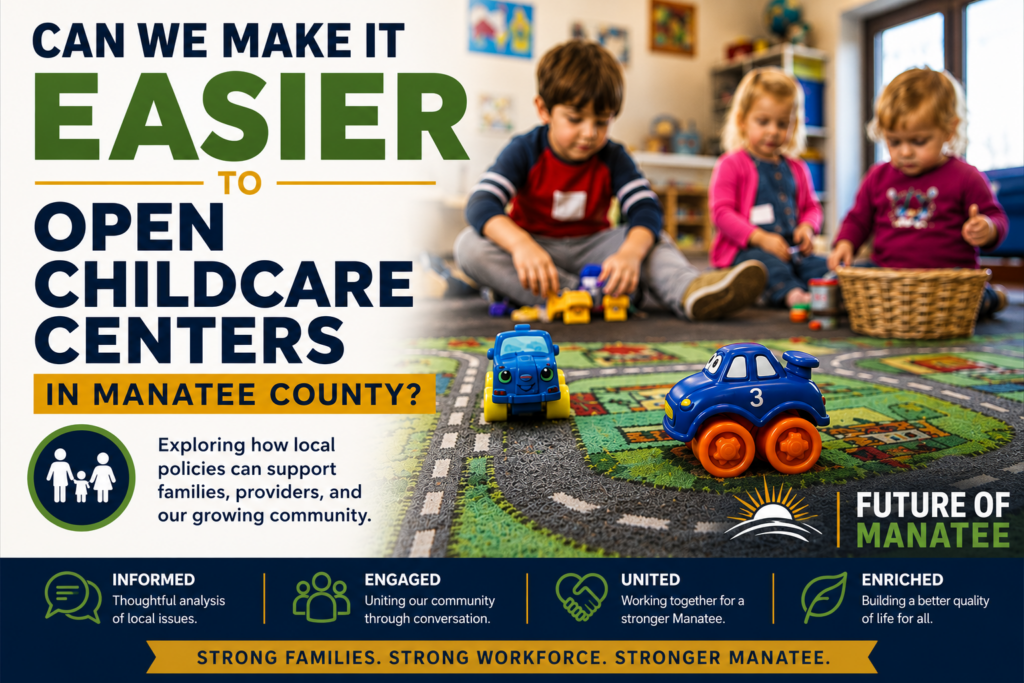
Can We Make It Easier to Open Childcare Centers in Manatee County?
Summary
When communities grow, we naturally plan for roads, schools, utilities, and public safety. Childcare rarely receives the same attention, even though it plays a critical role in workforce participation, economic growth, and family stability. As North River continues to expand, it may be worth asking whether childcare deserves a more prominent place in the conversation about growth.
Can We Make It Easier to Open Childcare Centers in Manatee County?
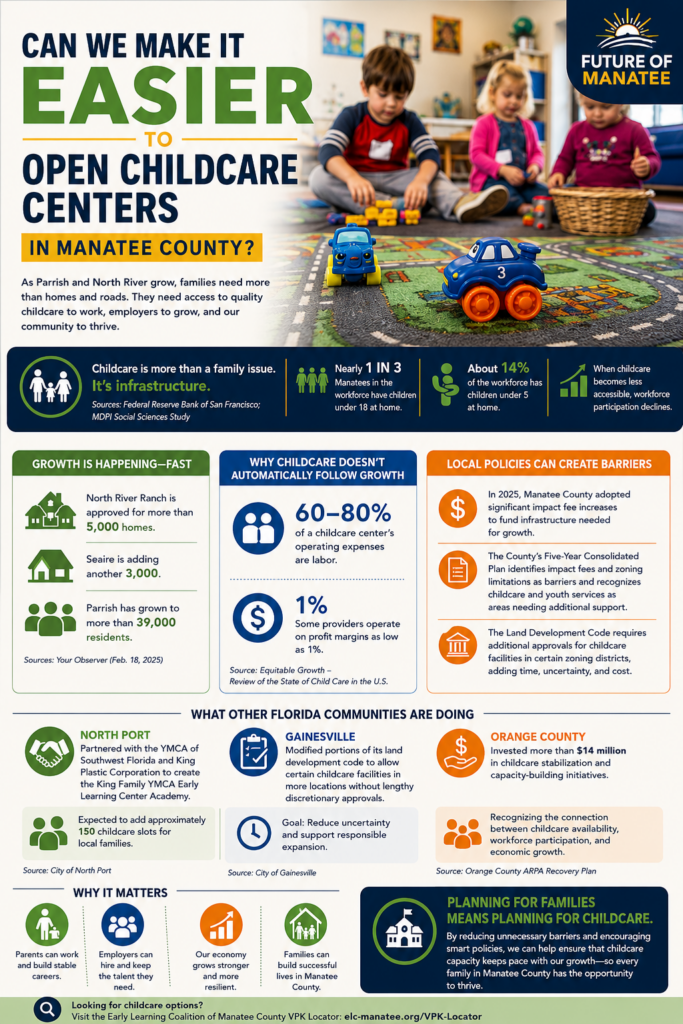
North River Ranch is approved for more than 5,000 homes. Seaire is adding another 3,000. The Observer reports that thousands of families have already moved into Parrish, and thousands more are on the way.
When communities grow this quickly, we expect roads, schools, utilities, and public safety services to expand alongside them. We rarely think about childcare in the same way.
That may be a mistake.
For many families, access to childcare is the difference between being able to work and being forced to rearrange careers, schedules, and finances around a lack of available options. Yet while new neighborhoods continue to rise across North River, childcare capacity often struggles to keep pace.
Parents find themselves on waitlists. Providers face challenges expanding. Employers lose workers. What appears to be a family issue quickly becomes an economic one.
Growth Is Arriving Faster Than Childcare Capacity
The challenge facing North River is the timing of growth.
Homes can be approved years before supporting services fully materialize. Roads, schools, and utilities are typically incorporated into long-range planning. Childcare often depends on separate private investment decisions made later in the process.
As a result, communities can experience a lag between population growth and childcare availability, particularly in areas attracting large numbers of young families.
The consequences extend far beyond individual households. Recent research examining childcare access and labor force participation found that when childcare becomes less accessible, workforce participation declines. The Federal Reserve has similarly described childcare as a critical component of economic infrastructure because it enables parents to remain active in the workforce. When childcare becomes scarce, the effects ripple outward through employers, healthcare providers, schools, local businesses, and the broader economy.
We typically think of infrastructure as something physical: roads, bridges, utility lines, and public buildings. But infrastructure is really anything a community depends upon to function. By that definition, childcare may be one of the least visible yet most important forms of infrastructure in a growing county.
Doesn’t Childcare Automatically Follow Growth?
At first glance, the solution seems straightforward. If demand exists, new providers should enter the market and build more capacity.
Childcare, however, operates under economic constraints that many people never see.
Unlike most businesses, childcare centers cannot dramatically increase productivity. State regulations establish strict child-to-staff ratios for obvious safety reasons, and those staffing requirements come with significant costs. Washington Center for Equitable Growth research suggests labor accounts for roughly 60-80% of a childcare center’s operating expenses. Some studies estimate that providers operate on profit margins as low as 1%.
Those numbers reveal why expanding childcare capacity can be so difficult.
A provider considering a new facility must absorb land costs, construction expenses, licensing requirements, insurance costs, staffing challenges, and months of lead time before a single child walks through the door. For businesses operating on razor-thin margins, even modest additional costs can affect whether a project moves forward.
None of this suggests that safety standards should be reduced. Parents deserve confidence that childcare facilities meet rigorous requirements. It does suggest that communities facing shortages should pay close attention to anything that makes expansion more difficult than it needs to be.
What Role Do Local Policies Play?
Manatee County is hardly alone in wrestling with these challenges.
County leaders have the responsibility of ensuring that growth pays for the infrastructure it requires. In 2025, Manatee County adopted significant impact fee increases to help fund roads, parks, libraries, public safety facilities, and other community needs created by rapid development.
Those investments are necessary, but they create an interesting policy tension.
Childcare centers are generally treated like other forms of commercial development. Providers seeking to open new facilities must navigate zoning requirements, development reviews, permitting processes, and impact fees before they can begin serving families.
Most of those requirements exist for legitimate reasons. The issue isn’t whether growth should pay for growth. The issue is whether childcare facilities should be viewed solely as another commercial use or as a form of workforce infrastructure that serves a broader public purpose.
Interestingly, Manatee County’s own planning documents acknowledge some of these challenges. Its Five-Year Consolidated Plan identifies impact fees and zoning limitations as barriers affecting certain community-serving uses and specifically recognizes childcare and youth services as areas needing additional support.
The county’s Land Development Code also requires additional approvals for childcare facilities in certain zoning districts. While those requirements are intended to ensure compatibility and appropriate planning, they can add time, uncertainty, and expense to projects that are already financially challenging.
Communities often discover that barriers which seem relatively small in isolation can become significant when combined. For a provider operating on a 1 percent margin, every month matters.
What Are Other Florida Communities Doing?
Fortunately, other Florida communities are already experimenting with ways to expand childcare capacity.
In North Port, local leaders helped facilitate a partnership between the YMCA of Southwest Florida and King Plastic Corporation to create the King Family YMCA Early Learning Center Academy. The project is expected to add approximately 150 childcare slots for local families.
What makes the example noteworthy isn’t simply the number of seats being added. It’s the recognition that childcare affects workforce participation, economic development, and quality of life. Rather than viewing childcare solely as a private business concern, community leaders treated it as part of the infrastructure needed to support a growing population.
Gainesville pursued a different approach by modifying portions of its land development code to allow certain childcare facilities in more locations without requiring lengthy discretionary approval processes. The goal was not to weaken standards. It was to reduce uncertainty for providers who already met those standards.
Orange County has invested more than $14 million in childcare stabilization and capacity-building initiatives, recognizing the connection between childcare availability, workforce participation, and long-term economic growth.
None of these communities found a single solution. Each approached the challenge differently. What they shared was a willingness to acknowledge that childcare shortages have consequences extending well beyond the families directly affected.
Planning For Families Means Planning For Childcare
Growth planning often focuses on what can be seen. New roads. New schools. New parks. New utility lines. Those investments matter, and communities cannot function without them.
But some of the most important infrastructure is less visible.
A parent who cannot find reliable childcare may struggle to keep a job. An employer who cannot find workers may struggle to grow. A community that attracts young families but fails to support them risks creating avoidable challenges for residents and businesses alike.
Manatee County has already demonstrated that it can think strategically about transportation, schools, healthcare, and economic development. As Parrish and North River continue to expand, childcare may deserve a place in those same conversations.
After all, a community isn’t defined only by the homes it builds. It’s also defined by whether the families living in those homes can build successful lives there.
Key Takeaways
- North River Ranch is approved for more than 5,000 homes, while Seaire is expected to add another 3,000, bringing thousands of new families to Parrish and North River.
- Childcare shortages affect more than parents. Research shows that access to childcare influences workforce participation, employee retention, and local economic growth.
- Childcare providers face unique financial challenges, with labor accounting for 60% to 80% of operating expenses and some centers operating on profit margins as low as 1%.
- Manatee County’s growth-related impact fees, zoning requirements, and development approval processes can add costs and complexity for providers seeking to open new childcare facilities.
- The county’s own planning documents identify childcare and youth services as areas needing additional support and recognize barriers such as impact fees and zoning limitations.
- Other Florida communities are exploring solutions, including employer partnerships, streamlined approvals, and childcare capacity investments designed to support growing populations.
- As Parrish and North River continue to expand, childcare may deserve to be considered alongside roads, schools, utilities, and healthcare as an essential component of community infrastructure.
Frequently Asked Questions
Is Manatee County experiencing a childcare shortage?
Many parents and childcare providers would say yes, particularly in fast-growing areas such as Parrish and North River. While thousands of new homes have been built or approved in recent years, childcare capacity has not always expanded at the same pace. This has led to waitlists and increased competition for available childcare slots.
Why can’t private businesses simply build more childcare centers?
Childcare centers operate under unique economic constraints. Providers must meet strict staffing and safety requirements, absorb significant startup costs, recruit qualified employees, and often operate on very thin profit margins. Even when demand exists, opening a new center can be financially challenging.
Does this article suggest lowering childcare safety standards?
No. Safety standards protect children and give parents confidence in the quality of care their children receive. The discussion is focused on whether permitting, zoning, impact fees, and other development processes can be structured in ways that encourage childcare expansion while maintaining high standards.
What are impact fees, and why do they matter?
Impact fees are charges assessed on new development to help fund infrastructure such as roads, parks, libraries, and public safety facilities. Childcare centers are generally subject to many of the same development costs as other commercial projects. Because childcare providers often operate on very narrow margins, those costs can influence whether a new facility moves forward.
What are other Florida communities doing to address childcare shortages?
Communities across Florida are experimenting with different approaches. North Port recently partnered with the YMCA and a local employer to help create approximately 150 new childcare slots. Gainesville revised portions of its development code to make it easier for certain childcare facilities to locate in more areas. Orange County has invested millions of dollars in childcare stabilization and capacity-building programs.
Is childcare really an economic issue?
Yes. Research has shown that childcare availability affects workforce participation. When parents cannot find reliable childcare, some reduce their work hours, delay returning to work, or leave the workforce altogether. That can affect local employers, economic growth, and overall community prosperity.
What role should local government play in childcare?
Reasonable people may disagree on the specifics, but many communities are exploring ways to reduce barriers, encourage partnerships, and support childcare expansion without directly operating childcare centers themselves. The goal is often to help create conditions that make it easier for private and nonprofit providers to serve growing populations.
Why is this issue especially important in Parrish and North River?
Parrish and North River are among the fastest-growing areas in Manatee County. Thousands of new homes have been approved or constructed, attracting large numbers of young families. As growth continues, ensuring that childcare capacity keeps pace with population growth will become increasingly important for residents, employers, and the broader community.
What would success look like?
Success would not necessarily mean a single policy change or government program. It would mean that families moving into Manatee County can find quality childcare without lengthy waitlists, providers can expand when demand exists, and employers have access to the workforce they need to support a growing local economy.
Related Articles
Is Manatee County a Net Exporter of Labor?
Learn why thousands of residents leave the county each day for work and how creating more local job opportunities can strengthen families, reduce traffic, and improve quality of life.
Are Manatee County Residents Really Getting Ahead?
Explore the relationship between income growth, rising costs, and why many residents still feel financially squeezed despite positive economic indicators.
Why Housing Feels Unaffordable in Manatee County
Understand how wages, housing costs, and economic opportunity are interconnected and why local job growth matters to affordability.
Stay Connected
The future of Manatee County will be shaped by the decisions we make today. If you found this article helpful, I invite you to follow my Facebook page for regular updates, new articles, community discussions, and insights into the issues shaping the future of Manatee County.
Together, we can build a future where more residents have the opportunity to live, work, and play in the same community they proudly call home.