
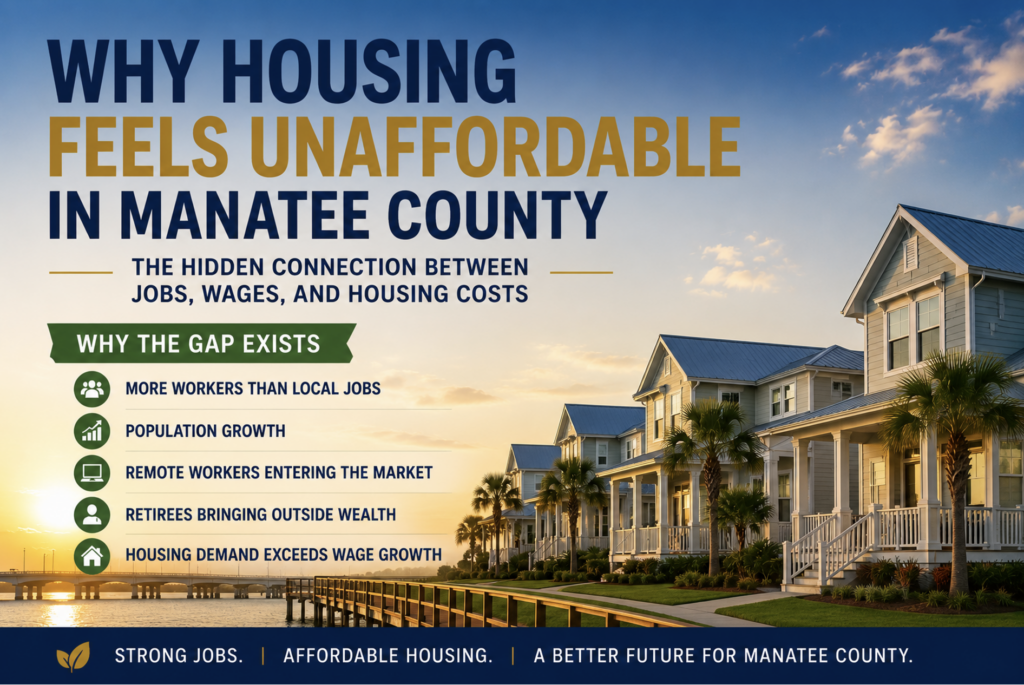

Why Housing Feels Unaffordable in Manatee County
The Hidden Connection Between Jobs, Wages, and Housing Costs
Summary
Housing affordability has become one of the biggest challenges facing Manatee County residents. While rising home prices often receive the most attention, another important part of the story receives far less discussion: local wages.
For decades, Manatee County has had fewer jobs than workers, causing many residents to commute elsewhere for higher-paying employment opportunities. At the same time, rapid population growth, retirees, remote workers, and strong housing demand have pushed prices upward. The result is a growing gap between what many residents earn and what it costs to buy a home.
Understanding that gap is an important step toward building a county where more residents can afford to live, work, and raise a family.
Why Does Housing Feel So Expensive?
Ask almost any resident about the biggest challenges facing Manatee County, and housing affordability is likely to be near the top of the list. The issue is not simply that housing prices have increased. The challenge is that incomes have not always kept pace.
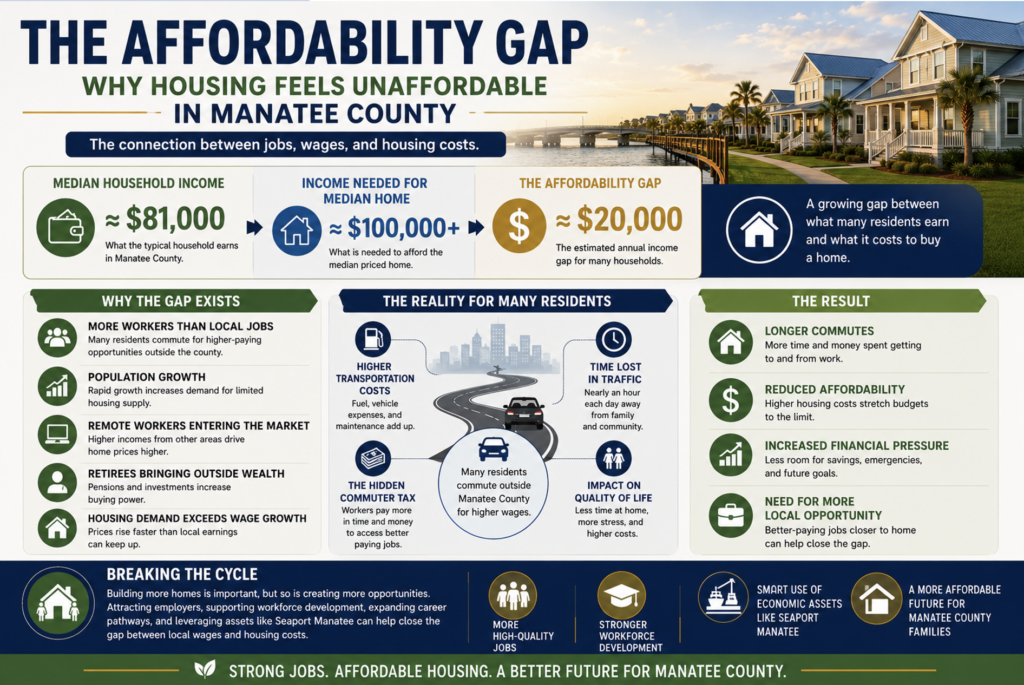
Today, the numbers tell a difficult story:
- Median household income: approximately $81,000
- Income needed to afford the median home: approximately $100,000+
- Estimated affordability gap: roughly $20,000 per year
For many families, that gap can make the difference between buying a home, delaying homeownership, or leaving the area altogether.
The Missing Part of the Conversation
Housing discussions often focus on supply, demand, interest rates, and new construction. Those factors certainly matter. However, there is another piece of the puzzle that deserves more attention: the local job market.
Manatee County has historically had fewer jobs than workers. Many residents travel to neighboring counties each day because higher-paying opportunities are often located elsewhere. When local wages lag behind housing costs, affordability becomes increasingly difficult to achieve. In many ways, the affordability challenge is not only a housing issue. It is also an income issue.
The Commuter Tax
For many residents, earning a higher income means driving outside the county for work. While those jobs may provide greater earning potential, commuting comes with costs that are often overlooked.
These costs include:
- Fuel and vehicle expenses
- Additional wear and tear on vehicles
- Higher transportation costs
- Time spent in traffic rather than with family
The average commuter may spend nearly an hour each day traveling to and from work. Over the course of a year, those hours add up quickly. In effect, many workers pay a hidden commuter tax simply to access employment opportunities that are not readily available closer to home.
Why Housing Demand Keeps Rising
Housing affordability is also affected by who is moving into the community.
Over the past two decades, Manatee County’s population has grown dramatically. New residents continue to be attracted by the area’s natural beauty, quality of life, and location within the Tampa Bay region.
Several groups have contributed to rising housing demand:
- Retirees with pension, investment, or retirement income
- Remote workers earning salaries from other markets
- Families relocating from higher-cost regions
- Commuters seeking housing alternatives to Tampa and surrounding areas
None of these trends are inherently negative. In fact, they reflect many of the qualities that make Manatee County an attractive place to live. The challenge arises when housing demand grows faster than local wages. As prices rise, workers employed in many of the county’s largest industries may find it increasingly difficult to afford housing in the community they serve.
The Wage-Price Gap
The affordability challenge becomes even clearer when comparing local earnings to housing costs.
Many of the county’s largest employment sectors include healthcare, retail, and construction. These industries play an essential role in the local economy and provide valuable careers for thousands of residents. However, the wages associated with many of these occupations often fall short of what is needed to comfortably afford today’s housing prices.
This creates a difficult situation for teachers, healthcare workers, service employees, tradespeople, and young professionals who want to build their futures in Manatee County. The issue is not a lack of hard work. The issue is a growing disconnect between local earnings and local housing costs.
Breaking the Cycle
Addressing affordability requires more than simply building additional housing. It also requires creating more opportunities for residents to earn higher incomes closer to home. That means attracting employers, supporting workforce development, expanding career pathways, and making better use of economic assets such as Seaport Manatee.
Economic development and affordability are often discussed as separate issues. In reality, they are closely connected. When communities create more high-quality jobs, they improve the ability of residents to afford housing, support local businesses, and build long-term financial stability.
Looking Ahead
Housing affordability is ultimately about opportunity.
A strong community should allow residents not only to find a home, but also to build a career, raise a family, and enjoy a high quality of life. By creating more jobs closer to home and making better use of assets like Seaport Manatee, Manatee County can strengthen its economy while improving quality of life.
The goal is not simply to accommodate growth. The goal is to create a future where prosperity is more accessible to the people who live here today and to the generations that will follow. The future of Manatee County should be a place where more residents have the opportunity to live, work, and play in the same community they proudly call home.
Key Takeaways
- Housing affordability is influenced by both housing costs and local wages.
- Median household income falls short of what is needed to comfortably afford the median-priced home.
- Many residents commute outside the county to access higher-paying jobs.
- Commuting creates additional financial and quality-of-life costs.
- Expanding local employment opportunities can help improve affordability over time.
- Economic development and housing affordability are closely connected.
Want to Dive Deeper?
This article summarizes key findings from research and data prepared for the Future of Manatee County initiative. Readers interested in reviewing the underlying data, charts, and supporting analysis can access the full report below.
Get Inside the Trends and Statistics
Frequently Asked Questions
Why has housing become less affordable in Manatee County?
Housing demand has increased rapidly due to population growth, retirees, remote workers, and other factors, while local wages have not always kept pace.
What is the affordability gap?
The affordability gap is the difference between what households earn and what is needed to comfortably afford housing in the current market.
How does labor export affect affordability?
When higher-paying jobs are concentrated outside the county, many residents must commute elsewhere for work, creating additional costs and limiting local wage growth.
Can economic development improve affordability?
Over time, attracting employers and creating higher-paying jobs can help residents earn incomes that better align with housing costs.
What role can Seaport Manatee play?
Seaport Manatee can support business recruitment, logistics, manufacturing, and other industries capable of creating additional employment opportunities within the county.
Related Articles
Is Manatee County a Net Exporter of Labor?
Learn why thousands of residents leave the county each day for work and how creating more local job opportunities can strengthen families, reduce traffic, and improve quality of life.
Are Manatee County Residents Really Getting Ahead?
Explore the relationship between income growth, rising costs, and why many residents still feel financially squeezed despite positive economic indicators.
Is Florida Headed for Another Housing Crash?
Florida faces serious housing challenges, but the conditions driving today’s market are very different from those that led to the collapse of 2008.
What Is Seaport Manatee and Why Does It Matter?
Seaport Manatee, a major gateway for trade, may be one of the most important economic assets in Florida and one of the greatest opportunities for Manatee County’s future.
Stay Connected
The future of Manatee County will be shaped by the decisions we make today. If you found this article helpful, I invite you to follow my Facebook page for regular updates, new articles, community discussions, and insights into the issues shaping the future of Manatee County.
Together, we can build a future where more residents have the opportunity to live, work, and play in the same community they proudly call home.