You may also be interested in...
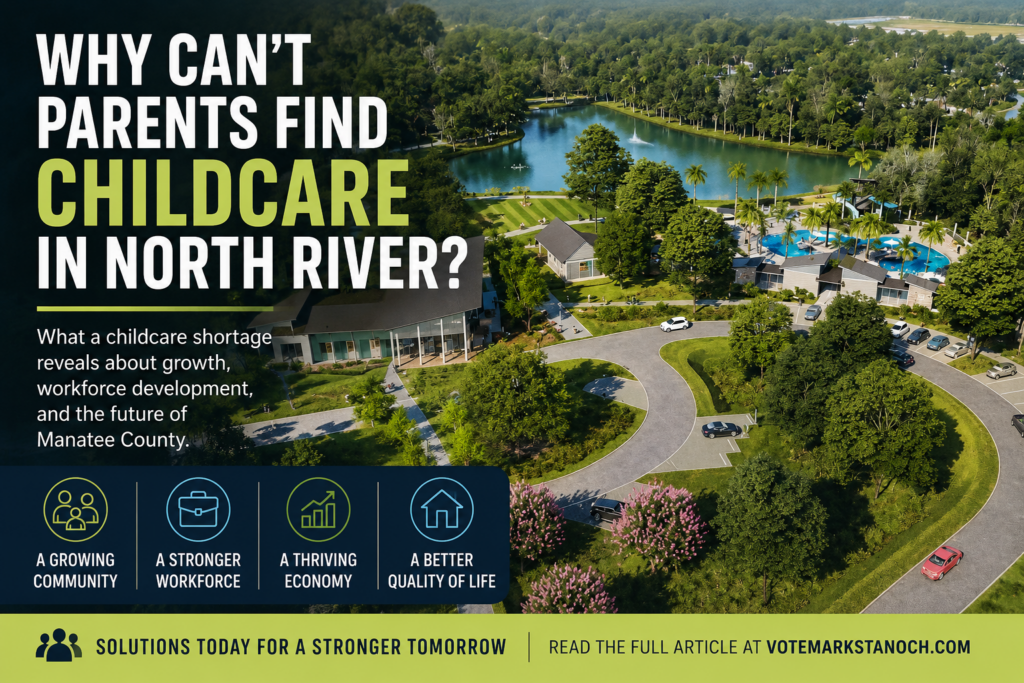
Why Can’t Parents Find Childcare in North River?
What a Childcare Shortage Reveals About Growth, Workforce Development, and the Future of Manatee County
Summary
North River and Parrish have become some of the fastest-growing communities in Manatee County, attracting thousands of new families seeking opportunity, excellent schools, and a high quality of life. Yet as neighborhoods continue to expand, many parents are discovering that one essential piece of family infrastructure may not be keeping pace: childcare. While roads, schools, and housing often dominate conversations about growth, childcare plays a critical role in workforce participation, economic development, and quality of life. Other Florida communities are beginning to recognize this connection. Perhaps it’s time for Manatee County to do the same.
North River May Be One of the Best Places in Florida to Raise a Family
Which makes it all the more interesting that one of the biggest challenges facing many young families has nothing to do with schools, crime, or housing.
It’s childcare.
For years, North River and Parrish have attracted families looking for more space, strong schools, and an exceptional quality of life. New neighborhoods continue being developed, bringing new opportunities and new energy to the region. The growth has been remarkable, and in many respects, it has been a success story.
But growth has a way of revealing challenges that don’t always appear on planning maps or economic reports.
One of those challenges may be childcare.
As more families move into North River, questions are beginning to emerge about whether the infrastructure that supports working parents is expanding as quickly as the neighborhoods themselves.
North River’s Growth Story Is Also an Infrastructure Story
The numbers help explain why this conversation matters.
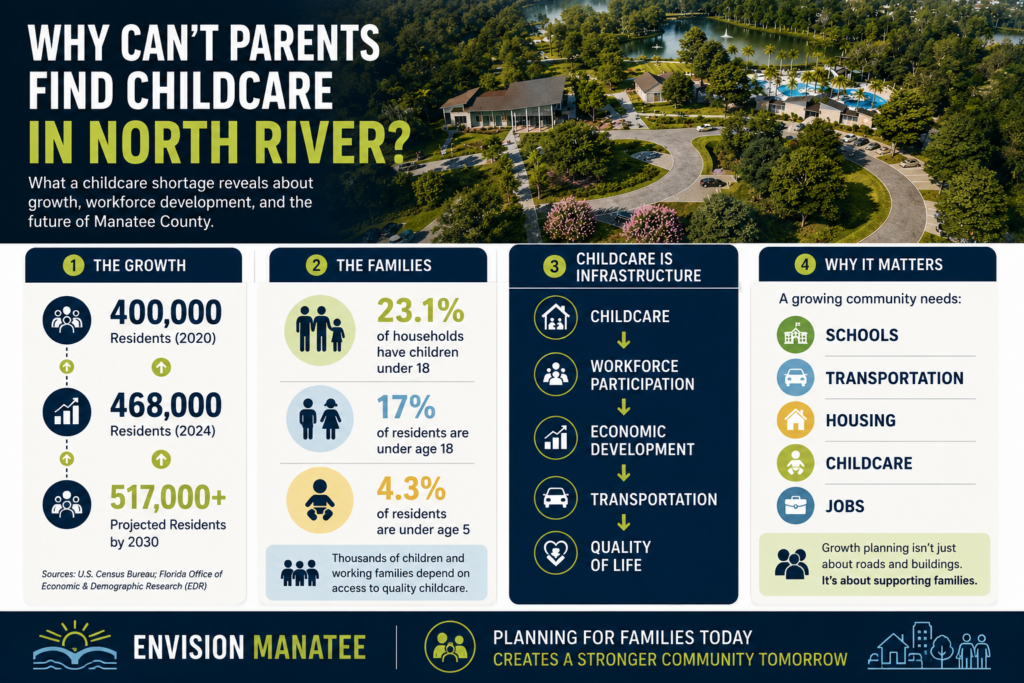
Between 2020 and 2024, Manatee County’s population grew from approximately 400,000 residents to more than 468,000, an increase of roughly 17% in just four years. Looking ahead, projections from the Florida Legislature’s Office of Economic and Demographic Research suggest the county’s population could exceed 517,000 residents by 2030.
That means roughly 50,000 additional residents could arrive over the next five years alone.
Much of that growth is occurring in Parrish and the broader North River area. Drive along Moccasin Wallow Road, Erie Road, or Fort Hamer Road and the evidence is impossible to miss. New homes, new schools, new businesses, and new families continue reshaping the landscape.
Growth itself is not the problem. Growth is often a sign that people recognize opportunity.
The challenge is ensuring that the infrastructure supporting those families grows alongside them.
When communities grow faster than they plan, the results are often familiar. Traffic increases. Schools become crowded. Housing affordability becomes more difficult. Sometimes the less obvious challenges receive less attention even though they affect daily life just as profoundly.
Childcare may be one of those challenges.
The Demographics Tell an Important Story
According to the U.S. Census Bureau, approximately 17% of Manatee County residents are under the age of 18. Roughly 4.3 percent are under the age of five, while 23% of households have children under 18 living at home.
Those numbers represent tens of thousands of children and families.
They also help explain why childcare deserves a place in conversations about growth.
North River has become especially attractive to young families. While coastal portions of the county tend to have older populations, many of the new communities in Parrish are specifically marketed to families raising children. As more families move into the area, demand for schools, parks, recreation programs, healthcare services, and childcare naturally increases as well.
The question is not whether demand is growing. The question is whether capacity is growing at the same pace.
Childcare May Be the Infrastructure Nobody Talks About
When most people hear the word infrastructure, they think of roads, bridges, utilities, and public buildings.
They’re not wrong. But for working families, childcare is infrastructure too.
Without reliable childcare, parents cannot fully participate in the workforce. Employers struggle to recruit and retain employees. Family schedules become more complicated. Economic opportunities become harder to pursue.
This is why an increasing number of economic development professionals have begun looking at childcare through a different lens. Rather than viewing it solely as a family issue, they increasingly view it as a workforce issue and an economic development issue.
A community’s ability to attract and retain workers depends, in part, on whether working families can find the support systems they need.
Childcare is one of those support systems.
A Growing Community, But Limited Childcare Options
A review of childcare and VPK providers serving Parrish and the immediate North River area reveals a relatively small number of facilities concentrated primarily along the US-301 corridor and a handful of nearby locations. At the same time, residential growth continues extending eastward and northward along corridors such as Moccasin Wallow Road and Rye Road.
The contrast is difficult to ignore.
While North River has become one of the county’s fastest-growing residential hubs, many childcare options remain concentrated in more established areas. Several providers serve the community admirably, but these questions remain worth exploring:
- Are childcare facilities being built in the same places where population growth is occurring?
- Are there enough infant and toddler care options for working families?
- How long are families waiting for available openings?
- What options exist for parents who require full-day rather than limited-hour programs?
The Numbers Behind the Conversation
- Manatee County’s population grew approximately 17% between 2020 and 2024.
- More than 468,000 people now call Manatee County home.
- The county’s population is projected to exceed 517,000 by 2030.
- Approximately 17% of residents are under age 18.
- Roughly 4.3% of residents are under age 5.
- More than 23% of households have children under 18.
The Hidden Cost of Distance
Most conversations about traffic focus on people commuting to work. Yet there may be another commute occurring every day that receives far less attention.
A parent drops off a child before work. If nearby childcare options are unavailable, that drop-off may require driving outside the immediate area before continuing to an office, job site, or workplace. At the end of the day, the process repeats itself in reverse.
For many families, those extra trips become part of everyday life.
Traffic is not always caused by jobs alone. Sometimes it is influenced by the distance between where families live and where essential services are located. This is one reason childcare deserves a place in larger conversations about transportation, workforce development, and quality of life.
Many of the challenges facing growing communities are interconnected:
Housing affordability affects workforce development → Workforce development affects economic growth → Economic growth affects transportation → Transportation affects quality of life.
Childcare touches every link in that chain.
Why Business Leaders in Naples Started Talking About Childcare
Southwest Florida has been wrestling with many of the same issues.
In Naples, business leaders and economic development organizations reached an important conclusion: childcare is not simply a social service. It is a workforce necessity.
Their reasoning was straightforward. Employers need workers. Workers need childcare.
Without reliable childcare options, workforce participation becomes more difficult. Parents face harder choices about employment, schedules, and career advancement. Businesses face greater challenges recruiting and retaining talent.
Recognizing this connection, leaders in Naples began exploring ways to increase childcare capacity and remove barriers that might prevent new providers from opening where they are needed most. Whether those same approaches would work in Manatee County is an open question. But the conversation itself is worth paying attention to.
Questions Worth Exploring in Manatee County
As North River continues to grow, several questions deserve thoughtful discussion:
- Are childcare facilities being developed where growth is occurring?
- Are there unnecessary barriers that make it difficult to establish new childcare centers?
- Can public and private partners work together to expand childcare capacity?
- What can Manatee County learn from other Florida communities?
- Should childcare infrastructure play a larger role in growth planning discussions?
These are planning questions. And the sooner we begin asking them, the better prepared we will be for the future.
Growth Means Planning for Families
Communities are often judged by how well they prepare for growth. Roads matter. Schools matter. Utilities matter. For many families, childcare may be just as important.
As North River and Parrish continue welcoming new residents, ensuring that family-supporting infrastructure keeps pace with growth will help preserve the quality of life that attracted so many people here in the first place. Growth is something we prepare for.
If we prepare thoughtfully and soon, growth can strengthen our economy, support working families, and create even greater opportunities for future generations.
Key Takeaways
- Manatee County’s population grew approximately 17% between 2020 and 2024.
- The county’s population is projected to exceed 517,000 residents by 2030.
- Approximately 23.1% of county households have children under 18.
- Childcare plays a critical role in workforce participation and economic development.
- North River’s rapid growth raises important questions about childcare capacity.
- Other Florida communities are beginning to view childcare as workforce infrastructure.
- Planning for growth means planning for the needs of families.
Frequently Asked Questions
Why is childcare being discussed as an economic development issue?
Reliable childcare helps parents participate in the workforce, which supports employers, economic growth, and workforce development.
Is North River growing faster than the rest of the county?
North River and Parrish have experienced significant residential growth and continue attracting large numbers of new families.
What can local government do?
Local governments can identify barriers, support planning efforts, encourage partnerships, and ensure that family-supporting infrastructure is considered alongside residential growth.
Why does this matter now?
Manatee County’s population is projected to exceed 517,000 residents by 2030. Planning ahead today may help avoid larger challenges tomorrow.
Related Articles
Is Manatee County a Net Exporter of Labor?
Learn why thousands of residents leave the county each day for work and how creating more local job opportunities can strengthen families, reduce traffic, and improve quality of life.
Are Manatee County Residents Really Getting Ahead?
Explore the relationship between income growth, rising costs, and why many residents still feel financially squeezed despite positive economic indicators.
Why Housing Feels Unaffordable in Manatee County
Understand how wages, housing costs, and economic opportunity are interconnected and why local job growth matters to affordability.
Stay Connected
The future of Manatee County will be shaped by the decisions we make today. If you found this article helpful, I invite you to follow my Facebook page for regular updates, new articles, community discussions, and insights into the issues shaping the future of Manatee County.
Together, we can build a future where more residents have the opportunity to live, work, and play in the same community they proudly call home.