You may also be interested in...
Florida is Growing by Millions.
What Does That Mean for Manatee County?
Summary
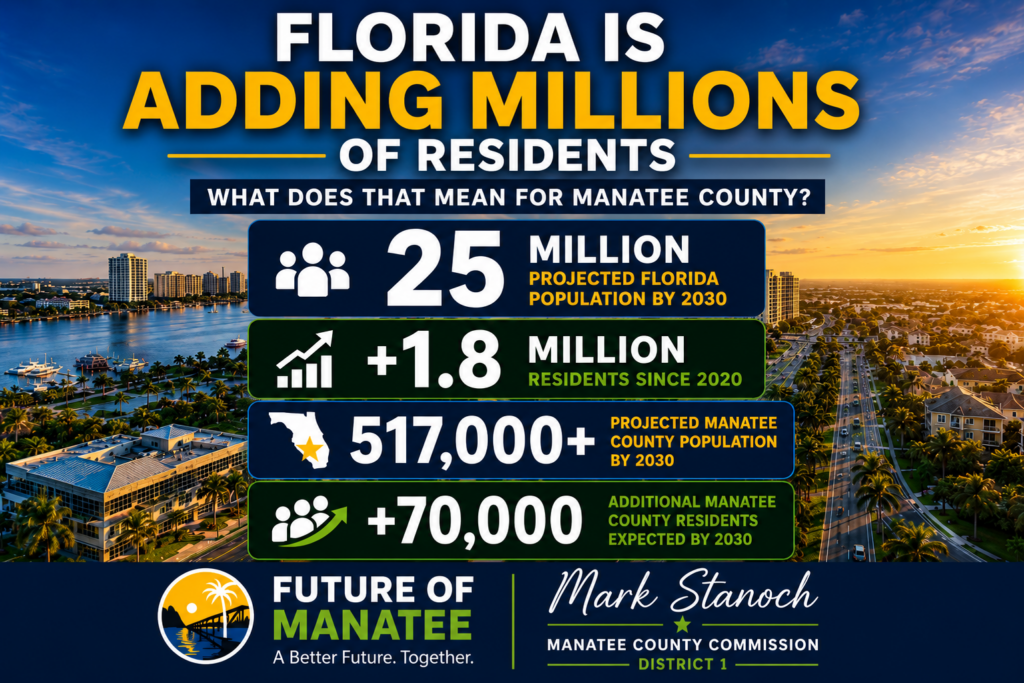
Growth is one of the most debated issues in Manatee County, but the real question isn’t whether growth will happen—it’s whether we’re prepared for it. With Florida projected to exceed 25 million residents and Manatee County expected to add roughly 70,000 more residents by 2030, this article examines what those trends mean for housing, traffic, jobs, infrastructure, and the future of our community.
Every conversation about growth eventually reaches the same point.
Someone says, “We need to stop all this growth.”
It’s an understandable reaction. Traffic feels worse than it used to. Housing costs have climbed. Schools, roads, and infrastructure often seem to be struggling to keep up with demand.
But there’s a problem with the idea that growth can simply be stopped. It’s already here.
While researching economic and demographic trends shaping Florida’s future, I recently reviewed a report from the Florida Legislature’s Office of Economic and Demographic Research titled Florida: An Economic Overview. Buried within its pages are several statistics that should matter to every resident of Manatee County.
According to the report, Florida is projected to surpass 25 million residents by 2030, continuing a decades-long pattern of population growth fueled primarily by people moving here from other states. More importantly, the report makes clear that this trend is expected to continue for years to come.
The implications for Manatee County are significant. According to population projections from the Florida Legislature’s Office of Economic and Demographic Research, Manatee County’s resident population is expected to exceed 517,000 residents by 2030. That’s an increase of roughly 70,000 additional residents—the equivalent of adding another small city to our county. These residents will need housing, transportation infrastructure, public services, childcare, schools, utilities, and employment opportunities.
For communities like Manatee County, that raises an important question:
Are we preparing for the county we’re becoming, or are we still planning for the county we used to be?
Florida’s Next Million Residents Won’t Stay on a Spreadsheet
It’s easy to think of population growth as an abstract number discussed by economists and planners. In reality, every new resident eventually becomes part of a community. They drive on local roads, purchase homes, enroll children in schools, visit local businesses, and depend on public services.
Here are a few key takeaways from the state report:
- Nearly 1.8 million net new residents have moved to Florida since the 2020 Census.
- Population growth is now driven almost entirely by migration.
- Florida’s long-term growth rate remains significantly higher than the national average.
- Much of the state’s future growth will occur in communities already experiencing infrastructure and housing pressures.
Those numbers may be statewide, but their impact is local.
Every additional resident creates both opportunity and demand. The challenge is ensuring our roads, schools, workforce, housing supply, utilities, and public services keep pace.
The Real Debate Isn’t Growth Versus No Growth
Growth discussions often get framed as a choice between two extremes. One side celebrates growth because it brings investment, jobs, customers, and economic activity. The other sees growth as the source of traffic congestion, rising housing costs, overcrowded schools, and pressure on public services.
The truth is that growth itself is neither good nor bad. What matters is whether a community plans for it.
Communities that anticipate growth can expand infrastructure, diversify their economies, strengthen workforce pipelines, and preserve quality of life. Communities that fail to plan often find themselves constantly reacting to problems that could have been addressed years earlier.
The difference isn’t growth. The difference is preparation.
Why More Residents Means More Than Just More Traffic
When people think about growth, traffic is often the first thing that comes to mind. But traffic is really just a symptom of a larger system.
More residents create increased demand for:
- Roads and transportation infrastructure
- Schools and educational resources
- Public safety services
- Water and utility systems
- Housing of all types and price points
- Parks, recreation, and community amenities
At the same time, growth can create significant opportunities:
- A larger workforce
- More entrepreneurship
- Greater business investment
- Expanded tax revenue
- Stronger economic diversification
Whether growth becomes an asset or a liability depends largely on whether these opportunities and challenges are addressed together.
Jobs, Housing, and Traffic Are All Connected
One of the most important lessons from studying economic development is that major community challenges rarely exist in isolation.
Housing affordability affects workforce development →
Workforce development affects economic growth →
Economic growth affects transportation →
Transportation affects quality of life.
Consider what happens when housing costs rise faster than local wages. Workers begin searching farther from their jobs for affordable housing. Others leave the county each day to pursue higher-paying opportunities elsewhere.
The result is more traffic, longer commutes, and less time spent with family and within the community.
That’s one reason why, in previous Future of Manatee articles, we’ve explored issues such as housing affordability, workforce development, income growth, and the fact that more than 88,000 Manatee County residents commute outside the county for work each day.
They’re not separate issues. They’re different parts of the same conversation.
The Counties That Think 10 Years Ahead Will Have the Advantage
The communities that thrive over the next decade will be the ones that prepare the smartest.
That means investing in workforce development, supporting educational partnerships, attracting employers that provide family-supporting careers, planning transportation improvements before congestion becomes overwhelming, and ensuring housing options for residents at different stages of life.
It also means recognizing that economic development and quality of life are not competing priorities. The strongest communities find ways to advance both at once.
As SeaPort Manatee expands, new industries emerge, and Florida’s population continues to grow, Manatee County has an opportunity to position itself as a community where residents can live, work, and play without sacrificing the qualities that attracted them here in the first place.
Preparing for the County We’re Becoming
Florida’s population will continue to grow. The state’s own economic forecasts leave little doubt about that reality.
For Manatee County, the challenge is not whether growth occurs. The challenge is making sure our infrastructure, workforce, housing supply, and economy evolve alongside it.
The decisions we make today will shape how residents experience this community ten, twenty, and thirty years from now. Communities that plan proactively tend to preserve more of what residents value. Communities that wait often find themselves trying to catch up.
Growth is not something that happens to us. It is something we prepare for. If we approach the future thoughtfully, growth can strengthen our economy, expand opportunities, and enhance quality of life. If we fail to plan, the same growth can place unnecessary strain on the systems residents rely on every day.
The future of Manatee County is being shaped right now. The question is whether we’re preparing for it.
Key Takeaways
- Florida is projected to exceed 25 million residents by 2030.
- Manatee County is projected to exceed 517,000 residents by 2030.
- Nearly 8 million net new residents have moved to Florida since the 2020 Census.
- Growth creates both opportunities and challenges for Manatee County.
- Housing, workforce development, transportation, and economic development are interconnected.
- Communities that plan ahead can maintain quality of life while benefiting from growth.
Want to Dive Deeper?
Many of the statistics and projections discussed in this article come from:
Florida: An Economic Overview
Florida Legislature Office of Economic and Demographic Research
January 20, 2026
Frequently Asked Questions
Is Florida still growing rapidly?
Yes. Florida continues to be one of the nation’s fastest-growing states and is projected to exceed 25 million residents by 2030.
What is driving Florida’s population growth?
Migration. The majority of Florida’s growth is coming from people moving to the state from elsewhere in the country.
Why does Florida’s growth matter to Manatee County?
Population growth affects housing demand, workforce needs, transportation infrastructure, public services, and economic development opportunities.
Can growth be stopped?
Realistically, no. The more productive question is how communities can prepare for growth in ways that preserve quality of life and create opportunity for residents.
Related Articles
Why Housing Feels Unaffordable in Manatee County
Understand how wages, housing costs, and economic opportunity are interconnected and why local job growth matters to affordability.
Is Manatee County a Net Exporter of Labor?
Learn why thousands of residents leave the county each day for work and how creating more local job opportunities can strengthen families, reduce traffic, and improve quality of life.
Are Manatee County Residents Really Getting Ahead?
Explore the relationship between income growth, rising costs, and why many residents still feel financially squeezed despite positive economic indicators.
What Is Seaport Manatee and Why Does It Matter?
Seaport Manatee, a major gateway for trade, may be one of the most important economic assets in Florida and one of the greatest opportunities for Manatee County’s future.
The future of Manatee County will be shaped by the decisions we make today. If you found this article helpful, I invite you to follow my Facebook page for regular updates, new articles, community discussions, and insights into the issues shaping our county.
Together, we can build a future where more residents have the opportunity to live, work, and play in the same community they proudly call home.