
You may also be interested in...


What Florida’s Property Tax Proposal Could Mean for Manatee County Homeowners
Summary
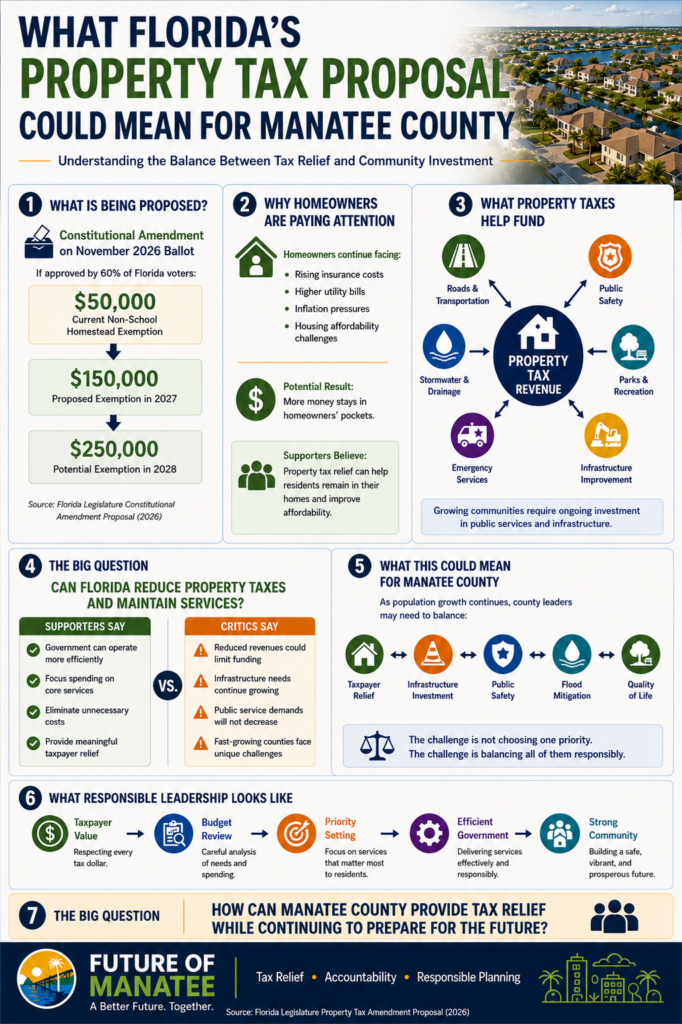
Governor Ron DeSantis’ major property tax amendment is headed to the November 2026 ballot, and it could significantly reduce property taxes for many Florida homeowners. If approved by voters, the proposal would increase Florida’s non-school homestead exemption from $50,000 to $150,000 in 2027 and potentially to $250,000 in 2028.
For many Manatee County homeowners, the prospect of meaningful tax relief is welcome news. But the proposal also raises important questions about how counties will continue funding roads, public safety, stormwater improvements, parks, and other essential services.
The real question is not whether tax relief is desirable. The question is how Florida can provide relief to homeowners while ensuring growing communities continue to receive the services they need.
Property Taxes and a Growing County
Property taxes are one of those issues that can unite people who disagree about almost everything else.
Whether you’ve lived in Manatee County for thirty years or moved here recently, chances are you’ve opened a property tax bill and wished it were lower. In a region where homeowners are already dealing with rising insurance premiums, higher utility costs, and inflation that has affected nearly every aspect of daily life, it is not difficult to understand why property tax relief has become such a popular topic.
That is precisely why a proposed constitutional amendment headed to Florida voters this November is generating so much attention. But beneath the headlines lies a more complicated question.
If Florida dramatically reduces one of the largest sources of local government revenue, what happens next?
That question deserves thoughtful consideration because Manatee County is not standing still. We are one of Florida’s fastest-growing communities. New residents continue to arrive, new neighborhoods continue to emerge, and demand for public services continues to increase.
The conversation is not simply about taxes. It is about how we prepare for the future while respecting taxpayers who are feeling the pressure of rising costs today.
What Is Actually Being Proposed?
The first thing to understand is that Florida has not eliminated property taxes. The Legislature has approved a constitutional amendment for the November 2026 ballot. It will only become law if at least 60 percent of Florida voters approve it.
If adopted, the proposal would:
- Increase the non-school homestead exemption from $50,000 to $150,000 in 2027
- Increase the exemption again to $250,000 in 2028
- Leave school district taxes largely unaffected
- Reduce annual assessment growth limits for many non-homestead properties from 10% to 5%
- Require new Florida residents arriving after 12/31/2026 to wait five years before qualifying for the expanded exemption
For a typical homesteaded homeowner, those changes could result in substantial savings.
Supporters view the amendment as a way to help residents remain in their homes and keep more of their hard-earned income. In a state where affordability has become a growing concern, that argument resonates with many Floridians.
Why Supporters Are Excited
The appeal of the amendment is easy to understand. Many homeowners feel like they are being squeezed from every direction. Insurance premiums have increased dramatically. Everyday expenses remain elevated. Housing affordability continues to be a challenge.
Against that backdrop, a proposal that could save homeowners hundreds or even thousands of dollars each year is understandably attractive. So, the issue is not simply about reducing taxes. It is about preserving financial stability and ensuring that long-time homeowners are not priced out of the communities they helped build.
That concern is legitimate. A healthy community should make it possible for residents to build roots, invest in their neighborhoods, and remain in their homes over the long term.
The Question Beneath the Question
What makes this debate so interesting is that it is really about more than taxes. It is about trust. Do residents trust local governments to spend their money wisely? And if revenues decline, do residents trust local governments to make thoughtful decisions about what comes next?
Manatee County residents want better roads. They want effective stormwater management. They want public safety services that can keep pace with growth. They want infrastructure investments that improve quality of life rather than simply reacting to problems after they emerge.
At the same time, they want government to be accountable. Those goals are not mutually exclusive. In fact, they should reinforce one another.
Can Florida Cut Property Taxes Without Cutting Services?
Supporters of the amendment argue that local governments can and should operate more efficiently. They believe tax relief will force government to focus on core responsibilities and eliminate spending that does not directly benefit residents.
Critics worry that reduced revenues could make it more difficult to fund infrastructure and essential services in fast-growing communities.
The truth is that both perspectives contain valid concerns.
Taxpayers deserve relief when possible. They also deserve safe communities, functional infrastructure, and responsible growth management. The challenge is finding the right balance.
What This Could Mean for Manatee County
If the amendment passes, county leaders will face important decisions about priorities. As our community continues to grow, investments in transportation, drainage, public safety, flood mitigation, and other core services will remain essential. Those responsibilities do not disappear simply because revenue structures change.
At the same time, taxpayers deserve confidence that every dollar is being spent wisely. That means evaluating programs carefully. It means focusing on outcomes rather than bureaucracy. And it means asking a simple question of every expenditure: Does this improve life for the residents who are paying the bill?
The goal should never be to preserve government spending for its own sake. The goal should be delivering value to taxpayers while ensuring the county remains prepared for the future.
What Responsible Leadership Looks Like
Too many public debates force people into opposing camps.
- Taxes versus services.
- Growth versus preservation.
- Development versus quality of life.
Real leadership recognizes that most issues are more complicated than that.
If this amendment passes, local leaders will have a responsibility to examine budgets carefully, prioritize essential services, eliminate waste where it exists, and ensure public resources are being used effectively.
The residents of Manatee County deserve leaders who are willing to ask difficult questions, evaluate competing priorities honestly, and focus on practical solutions rather than political talking points.
Looking Ahead
Florida voters will have the final say this November. Before then, we should have a serious and thoughtful conversation about what this proposal could mean for our homeowners, taxpayers, and community.
Property tax relief could provide meaningful benefits for many families. At the same time, we must ensure that Manatee County continues to invest in the infrastructure and services that support a growing population.
Key Takeaways
- Florida voters will consider a major property tax amendment in November 2026.
- The proposal would significantly expand Florida’s non-school homestead exemption.
- Many homeowners could see substantial tax savings.
- School district taxes would largely remain intact.
- Counties may need to reassess spending priorities if revenues decline.
- The debate is ultimately about balancing tax relief with responsible stewardship of public resources.
Frequently Asked Questions
Has Florida eliminated property taxes?
No. The Legislature has placed a constitutional amendment on the November 2026 ballot. Voters must approve it before any changes take effect.
How much would the homestead exemption increase?
The proposal would increase the non-school homestead exemption from $50,000 to $150,000 in 2027 and potentially to $250,000 in 2028.
Would school funding be affected?
The proposal leaves school district taxes largely unchanged, meaning school funding protections remain in place.
Why do supporters back the amendment?
Supporters believe homeowners need relief from rising costs and should be able to keep more of their income.
Why are local governments paying attention?
Property taxes fund many local services. Any significant reduction in revenue requires counties and municipalities to evaluate budgets and priorities carefully.
Related Articles
Are Manatee County Residents Really Getting Ahead?
Explore the relationship between income growth, rising costs, and why many residents still feel financially squeezed despite positive economic indicators.
Why Housing Feels Unaffordable in Manatee County
Understand how wages, housing costs, and economic opportunity are interconnected and why local job growth matters to affordability.
Is Florida Headed for Another Housing Crash?
Florida faces serious housing challenges, but the conditions driving today’s market are very different from those that led to the collapse of 2008.
The future of Manatee County will be shaped by the decisions we make today. If you found this article helpful, I invite you to follow my Facebook page for regular updates, new articles, community discussions, and insights into the issues shaping the future of Manatee County.
Together, we can build a future where more residents have the opportunity to live, work, and play in the same community they proudly call home.
Follow Mark Stanoch on Facebook