You may also be interested in…
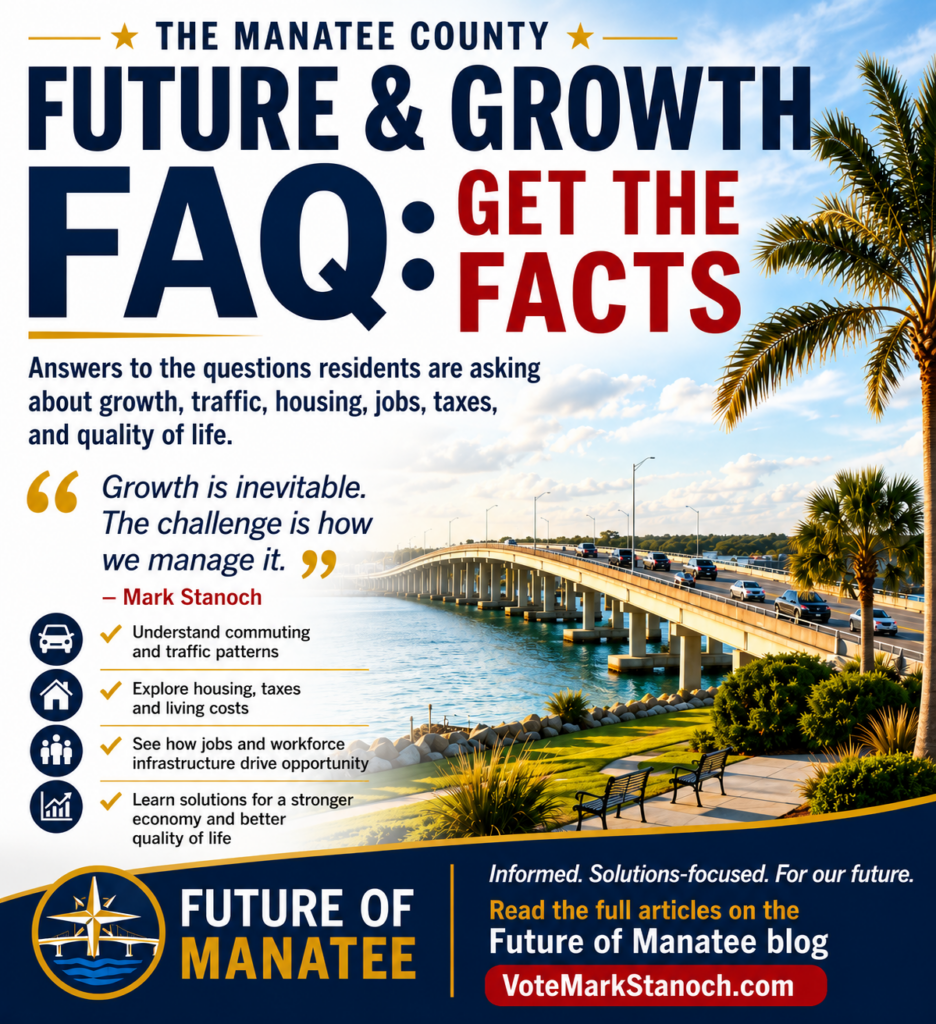
The Manatee County Future & Growth FAQ: Get the Facts
Answers to the Questions Residents Are Asking About Growth, Traffic, Housing, Jobs, Taxes, and Quality of Life
Summary
Growth is inevitable. The challenge is how we manage it.
Manatee County is one of Florida’s fastest-growing communities, and with that growth come important questions about traffic, housing affordability, economic development, agriculture, taxes, and quality of life.
Too often, these issues are discussed in isolation. In reality, they are closely connected. Housing affects traffic. Economic development influences housing affordability. Workforce participation depends on access to childcare and other essential services. Property tax policy affects the county’s ability to invest in infrastructure and public safety.
This FAQ brings together data from government agencies, independent research organizations, and the Future of Manatee series to answer many of the questions residents are asking. Each answer includes links to more detailed articles for readers who want to explore the topic further.
Growth, Traffic & Commuting
Is Manatee County a labor exporter or importer?
Net exporter, with 57.7% of working residents commuting outside of the county. For more than two decades, Manatee County has maintained an employment-to-residence ratio between approximately 0.83 and 0.87, meaning the county has consistently had fewer jobs than working residents. Simply put, we have built housing faster than we’ve created employment opportunities.
This imbalance has made Manatee County increasingly dependent on neighboring counties for jobs, contributing to longer commutes, increased traffic congestion, and fewer opportunities for residents to build careers close to home.
Related Future of Manatee Article
Is Manatee County a Net Exporter of Labor?
Primary Sources
- Florida Bureau of Workforce Statistics and Economic Research (WSER)
- Florida Commerce
- U.S. Census Bureau
What do the actual commuting numbers look like?
Regional workforce data shows that approximately 88,193 residents leave Manatee County each day for work, while roughly 57,931 workers commute into the county, resulting in a net daily outflow of 30,262 workers.
Those numbers demonstrate that Manatee County remains a net exporter of labor. Every day, tens of thousands of residents travel to neighboring counties for employment, while a smaller number commute here.
This daily movement places significant pressure on regional transportation corridors while shifting wages and consumer spending outside our local economy.
Related Future of Manatee Article
Is Manatee County a Net Exporter of Labor?
Primary Sources
- Florida Bureau of Workforce Statistics and Economic Research (WSER)
- Florida Department of Commerce
How does this labor export affect our daily traffic?
Traffic congestion is driven by more than population growth. It is also driven by where people work.
When tens of thousands of residents travel north and south on Interstate 75 and other major highways during the same morning and evening commute, congestion becomes predictable regardless of how many lanes are added.
Road improvements remain essential, but transportation projects alone cannot fully solve congestion if employment opportunities continue to lag behind residential growth.
Related Future of Manatee Article
Is Manatee County a Net Exporter of Labor?
Primary Sources
- Florida Bureau of Workforce Statistics and Economic Research (WSER)
- Florida Department of Transportation
Can economic development fix our transportation challenges?
Economic development is one of the most effective long-term traffic solutions available.
Bringing more high-paying jobs to Manatee County allows more residents to work closer to home, reducing commuting while strengthening the local economy. It also keeps more consumer spending within the county, supporting local restaurants, retailers, and small businesses.
Transportation improvements and economic development should work together. One addresses today’s congestion while the other helps reduce tomorrow’s.
Related Future of Manatee Article
What Is Seaport Manatee and Why Does It Matter?
Primary Sources
- Florida Bureau of Workforce Statistics and Economic Research (WSER)
- U.S. Bureau of Economic Analysis
Infrastructure & The Local Economy
What is workforce infrastructure?
Most people think of infrastructure as roads, bridges, utilities, and water systems. Workforce infrastructure refers to the network of businesses and services that make it possible for people to participate in the workforce.
This includes childcare centers, after-school programs, elder care providers, summer camps, commuter transportation, and other services that allow parents and caregivers to maintain full-time employment. These businesses are every bit as important to a healthy economy as roads and utilities because they help employers find workers and help families remain financially secure.
As Manatee County continues to grow, investing in workforce infrastructure should be viewed as an economic development strategy rather than simply a social service.
Related Future of Manatee Article
The Businesses That Help People Go to Work
Primary Sources
- Institute for Child Success
- Bipartisan Policy Center
- U.S. Chamber of Commerce Foundation
What is the actual economic cost of childcare shortages?
Insufficient childcare is more than an inconvenience for families. It creates measurable economic losses for workers, employers, and entire communities.
Research estimates that inadequate childcare costs the United States approximately $172 billion annually through lost earnings, reduced productivity, and lower tax revenues. Working parents frequently reduce their hours, turn down promotions, or leave the workforce entirely when reliable childcare is unavailable.
As North River and eastern Manatee County continue to experience rapid residential growth, expanding access to quality childcare will become increasingly important to attracting employers and supporting working families.
Related Future of Manatee Article
Can We Make It Easier to Open Childcare Centers in Manatee County?
Primary Sources
- Institute for Child Success
- Bipartisan Policy Center
- U.S. Chamber of Commerce Foundation
What is the economic cost of elder care on our workforce?
As the population ages, more working adults find themselves caring for aging parents or relatives while maintaining full-time jobs. Without adequate elder care services, many reduce their working hours or leave the workforce altogether.
National studies estimate that unpaid family caregiving results in approximately $522 billion annually in lost wages and productivity across the United States. At the same time, the cost of professional home care continues to rise, placing additional financial pressure on families.
Expanding access to adult day programs, respite care, and in-home care services allows more residents to remain employed while ensuring loved ones receive quality care.
Related Future of Manatee Article
The Businesses That Help People Go To Work
Primary Sources
- National Institutes of Health (NIH)
- AARP
- U.S. Department of Health & Human Services
What role can Seaport Manatee play in keeping jobs local?
Seaport Manatee is one of the county’s greatest economic assets. Beyond its role as a deep-water port, it serves as a gateway for international trade and supports thousands of jobs throughout the region.
Equally important is the approximately 5,000 acres surrounding the port that have been designated for future economic development. This area presents an opportunity to attract logistics, manufacturing, technology, research, and other high-paying industries that can diversify the local economy.
Expanding employment opportunities around Seaport Manatee would help reduce long-distance commuting, strengthen the commercial tax base, and create more career opportunities for local residents.
Related Future of Manatee Article
What Is Seaport Manatee and Why Does It Matter?
Primary Sources
- Seaport Manatee
- Manatee County Government
- Florida Department of Commerce
Housing, Taxes, & Living Costs
Are Manatee County residents actually getting ahead financially?
Although Manatee County’s economy continues to grow, many residents feel they are working harder simply to maintain the same standard of living.
Rising housing costs, insurance premiums, groceries, utilities, healthcare, and childcare have outpaced income growth for many families. While economic indicators often highlight population growth and increasing property values, those numbers do not always reflect what residents experience in their day-to-day finances.
The true measure of economic success is whether families have greater opportunities to build wealth, purchase a home, save for retirement, and improve their quality of life.
Related Future of Manatee Article
Are Manatee County Residents Really Getting Ahead?
Primary Sources
- U.S. Census Bureau
- Bureau of Labor Statistics
- Federal Reserve Economic Data (FRED)
How severe is the gap between local wages and housing costs?
The affordability gap has become one of Manatee County’s most significant economic challenges.
The median household income is approximately $78,500, while financial experts estimate that a household needs more than $100,000 annually to comfortably afford the median-priced home. That represents an affordability gap of roughly $21,500 per year.
This gap affects teachers, nurses, law enforcement officers, first responders, young professionals, and many other workers who are essential to our community. Closing that gap requires both increasing housing opportunities and expanding access to higher-paying careers.
Related Future of Manatee Article
Why Housing Feels Unaffordable in Manatee County
Primary Sources
- U.S. Census Bureau
- Florida Realtors®
- Federal Reserve Economic Data (FRED)
How does Florida’s property tax proposal impact residents?
Florida’s proposed changes to the homestead exemption could provide meaningful property tax relief for homeowners while reducing property tax revenue available to local governments.
Based on Mark Stanoch’s analysis of Manatee County property values and the proposed exemption levels, he estimates that increasing the homestead exemption to $150,000 could reduce county property tax revenues by approximately $80 million annually. If the exemption were increased to $250,000, he estimates the annual reduction could approach $149 million.
If those estimates prove accurate, Manatee County will need to identify new ways to fund essential services while maintaining fiscal responsibility. One long-term strategy is expanding the commercial tax base through responsible economic development, allowing additional business investment to help offset some of the reduction in residential property tax revenues.
Related Future of Manatee Article
What Florida’s Property Tax Proposal Could Mean for Manatee County Homeowners
Primary Sources
- Florida Office of Economic & Demographic Research (property tax data)
- Florida Department of Revenue
- Analysis by Mark Stanoch
Agriculture & Preservation
What is the true scale of agriculture in Manatee County today?
Agriculture remains one of Manatee County’s largest and most important industries. It contributes an estimated $290 million to $321 million annually to the local economy and encompasses approximately 219,000 acres of farmland. The county is also one of Florida’s leading producers of fresh market tomatoes, with more than 18,000 acres dedicated to tomato production.
Beyond crops, local agriculture supports livestock operations, nurseries, agricultural suppliers, transportation companies, equipment dealers, food processors, and countless small businesses. It also helps preserve the rural character that has long been part of Manatee County’s identity.
Related Future of Manatee Article
The Future of Farming in Manatee County
Primary Sources
- USDA Census of Agriculture
- Florida Department of Agriculture & Consumer Services
- UF/IFAS Extension
Can agriculture and development actually coexist?
Yes—but only through thoughtful planning.
Growth and agriculture should not be viewed as competing priorities. Manatee County can continue welcoming new residents while preserving productive farmland and supporting one of its most important industries.
The key is managing growth responsibly by directing development toward appropriate areas, investing in infrastructure, and maintaining policies that allow farms to remain economically viable. When agriculture is profitable, landowners are better positioned to continue farming rather than selling productive land for development.
Responsible growth means creating complete communities while preserving the industries and landscapes that make Manatee County unique.
Related Future of Manatee Article
The Future of Farming in Manatee County
Primary Sources
- Manatee County Comprehensive Plan
- UF/IFAS Extension
- Florida Department of Agriculture & Consumer Services
How does the future of local farming rely on innovation?
Today’s farms are highly sophisticated businesses that rely on technology as much as tradition.
Many operations now use GPS-guided equipment, drone mapping, precision irrigation, soil moisture sensors, and data analytics to improve yields while conserving water and reducing costs. These technologies help farmers remain competitive despite rising operating expenses, labor shortages, and weather-related challenges.
Supporting agricultural innovation helps ensure farming remains both environmentally responsible and economically sustainable for future generations.
Related Future of Manatee Article
The Future of Farming in Manatee County
Primary Sources
- UF/IFAS Extension
- USDA
- Florida Department of Agriculture & Consumer Services
Why are agricultural leaders supporting Mark Stanoch?
Many agricultural leaders appreciate Mark’s belief that preserving agriculture requires more than protecting land—it requires protecting the long-term economic viability of farming.
His approach emphasizes responsible growth management, infrastructure improvements, predictable land-use policies, workforce development, and practical economic solutions that allow farms to remain competitive while preserving Manatee County’s rural heritage.
Rather than viewing agriculture as separate from economic development, Mark believes it should remain one of the county’s foundational industries as Manatee County continues to grow.
Related Future of Manatee Article
The Future of Farming in Manatee County
Primary Sources
- Mark Stanoch campaign platform
- UF/IFAS Extension
- Florida Department of Agriculture & Consumer Services
About the Future of Manatee Series
The Future of Manatee blog series explores the issues shaping Manatee County’s future through research, data, and practical solutions. Each article examines a different aspect of growth—from housing affordability and transportation to economic development, agriculture, childcare, and property taxes—while emphasizing how these issues work together.
The goal is simple: provide residents with reliable information that encourages thoughtful discussion about the future of our community and helps make Manatee County the premier place to Live, Work, and Play.
Stay Connected
The future of Manatee County will be shaped by the decisions we make today. If you found this article helpful, I invite you to follow my Facebook page for regular updates, new articles, community discussions, and insights into the issues shaping the future of Manatee County.
Together, we can build a future where more residents have the opportunity to live, work, and play in the same community they proudly call home.