
You may also be interested in...
The Businesses That Help People Go To Work
Why Workforce Infrastructure May Be the Missing Piece of Economic Development
Summary
When we think about economic development, we usually picture new employers, manufacturing facilities, office buildings, and ribbon cuttings celebrating the creation of hundreds of new jobs.
But there is another side of economic development that rarely receives the attention it deserves. Before someone can accept a better job, someone has to care for their child. Before they can work a full day, an aging parent may need assistance. Before they can pursue a promotion or work overtime, they need reliable transportation, after-school care, or other support services that make everyday life manageable.
These businesses don’t simply create jobs of their own. They make it possible for thousands of other people to participate in the workforce. Recognizing the importance of these businesses may be one of the smartest investments we can make in the Manatee County economy.
Looking Beyond Job Creation
Over the past several weeks, we’ve looked at housing affordability, childcare shortages, workforce commuting, property taxes, and the need to attract more high-paying employers. Those topics may seem unrelated, but they all point to the same fundamental question.
What makes it possible for people to build successful lives in Manatee County?
That question changes the way we think about economic development.
Imagine you’ve just been offered the job you’ve been hoping for. The salary is better, the benefits are stronger, and the office is only fifteen minutes from home instead of nearly an hour away. It feels like everything you’ve been working toward is finally coming together.
Then reality intervenes.
Your childcare provider has a waiting list. School dismisses two hours before your workday ends. Your father needs someone to drive him to medical appointments every Tuesday and Thursday. Your spouse’s work schedule leaves little flexibility.
The job isn’t the obstacle. Everything surrounding the job is.
A Different Way to Think About Infrastructure
When most people hear the word infrastructure, they think about roads, bridges, water lines, utilities, airports, and ports. Those investments are essential because they allow communities to function and businesses to operate.
But there is another form of infrastructure that receives far less attention, even though it affects thousands of working families every single day.
I think of it as workforce infrastructure.
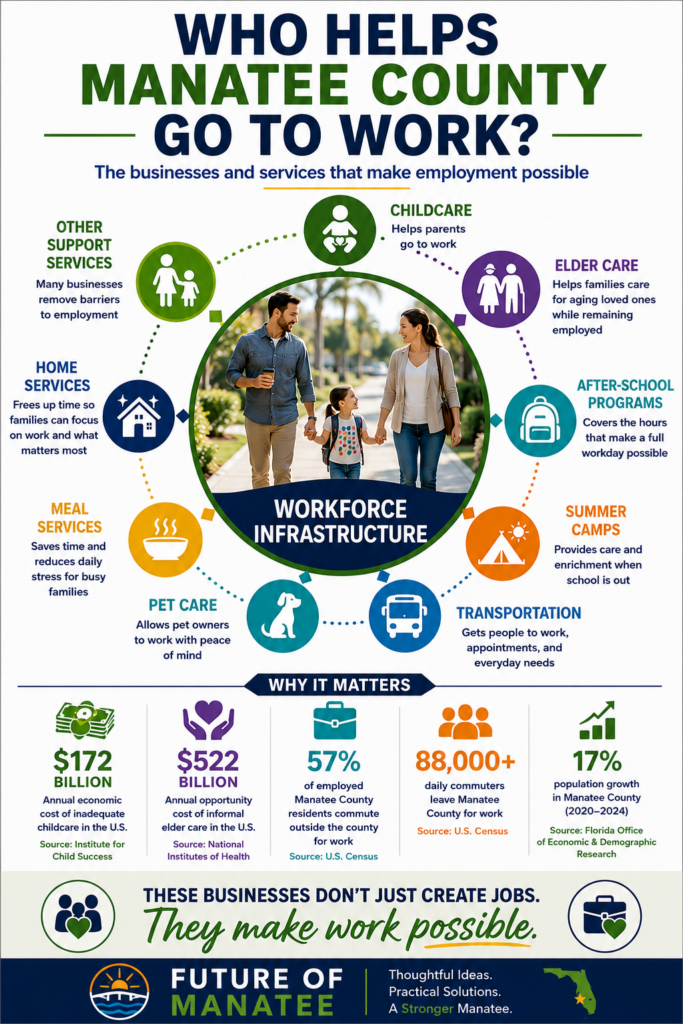
Workforce infrastructure is the network of businesses and services that enables people to participate in the workforce. Childcare providers, after-school programs, summer camps, elder care services, transportation providers, and other support businesses all perform an economic function that extends far beyond the services they provide. They remove barriers that prevent people from working, pursuing promotions, accepting new jobs, or remaining in the workforce altogether.
A childcare center may employ twenty people, but it makes it possible for hundreds of parents to go to work every morning. An adult day care program may serve only a few dozen seniors, yet it allows their adult children to remain employed instead of becoming full-time caregivers. An after-school program occupies only a few classrooms for a few hours each afternoon, but those hours can determine whether parents are able to complete a full workday.
These businesses don’t simply support families. They support our economy.
Childcare Is Economic Infrastructure
Earlier in this series, I wrote about the challenges many Manatee County families face when searching for affordable, accessible childcare. We explored whether local policies unintentionally make it more difficult to open childcare centers by treating them much like any other commercial development.
The more I researched the issue, the more I realized we often frame childcare as a family issue when it is equally an economic issue.
According to the Institute for Child Success, insufficient childcare costs the United States an estimated $172 billion every year in lost earnings, lower productivity, and reduced tax revenue. Working families account for approximately $134 billion of those losses, while employers absorb another $38 billion through absenteeism, employee turnover, and reduced productivity. The Bipartisan Policy Center estimates that the long-term economic cost of inadequate childcare could exceed $300 billion over the next decade if access does not improve.
Those are national numbers, but the underlying reality exists here in Manatee County as well.
Our county’s population grew by approximately 17% between 2020 and 2024, and projections indicate we could exceed 517,000 residents by 2030. At the same time, we’ve already discussed the growing gap between local household incomes and the cost of purchasing a home. For many families, maintaining financial stability requires two working adults. That becomes much harder when dependable childcare is unavailable or unaffordable.
Every time a parent turns down a promotion, reduces their hours, or leaves the workforce because childcare cannot be found, our local economy loses productive capacity. Businesses struggle to fill positions. Families postpone financial goals. Employers lose experienced workers. What appears to be a childcare challenge quickly becomes a workforce challenge.
Caring for Aging Parents Shouldn’t Mean Leaving the Workforce
Childcare is only one part of the picture. As our population ages, another challenge is quietly reshaping the workforce in Manatee County and across the country.
Millions of Americans now find themselves caring not only for children, but also for aging parents. They are balancing careers with medical appointments, transportation needs, medication management, and the daily responsibilities that come with helping a loved one remain independent.
These family caregivers perform an extraordinary service, but many do so at a tremendous personal and financial cost.
Research published by the National Institute of Health estimates that the employment-related opportunity cost of informal elder care exceeds $522 billion annually in the United States. Adult children often reduce their work hours, decline promotions, postpone career opportunities, or leave the workforce entirely because formal care options are unavailable or unaffordable. According to AARP, the median annual cost of home care has climbed to more than $51,000, placing additional strain on working families.
When we think about elder care solely as a healthcare issue, we overlook its broader impact on our local economy. Adult day programs, in-home care agencies, respite care providers, and non-emergency medical transportation services don’t simply care for seniors. They make it possible for sons, daughters, and spouses to remain productive members of the workforce.
The Hours Between Three and Five Matter
For many working parents, the most difficult part of the day isn’t the morning. It’s the two or three hours between the end of the school day and the end of the workday. That small window of time creates a surprisingly large challenge. Parents leave work early, adjust schedules, rely on neighbors, or simply hope nothing unexpected happens before they arrive home.
Businesses that provide after-school programs, summer camps, and extended-day care quietly solve that problem every day.
They may not appear on most lists of economic development priorities, yet their impact reaches far beyond the families they serve. The Afterschool Alliance estimates that quality after-school programs generate at least a $3 return for every $1 invested by reducing absenteeism, improving workforce participation, and helping parents remain employed. The Brookings Institute has also noted that as more households depend on two incomes, structured out-of-school programs have become an essential part of a functioning modern workforce.
These programs aren’t simply recreational opportunities for children. They are part of the infrastructure that allows parents to work with confidence, accept additional responsibilities, and pursue career advancement without constantly worrying about what happens after the school bell rings.
Transportation Doesn’t Just Move People. It Moves Opportunity.
In a previous Envision Manatee article, I emphasized that 57% of employed Manatee County residents leave the county each day for work. That means more than 88,000 people spend hours each day commuting to jobs elsewhere.
Traffic congestion is often discussed as a road construction problem, but it is also an economic development problem. Every hour spent commuting is an hour not spent with family, volunteering in the community, supporting local businesses, or participating in civic life. Long commutes also increase transportation costs, reduce quality of life, and make it more difficult for employers within Manatee County to compete for talent.
That’s one of the reasons I’ve consistently argued that traffic cannot be solved by roads alone.
If we create more high-paying jobs here in Manatee County, we reduce the need for thousands of residents to leave the county every morning. At the same time, transportation services, commuter options, and mobility improvements help connect people with the jobs that already exist.
Transportation doesn’t simply move people. It moves opportunity.
The Businesses We Rarely Think About
Once you begin looking at the economy through the lens of workforce infrastructure, you start noticing businesses that are rarely included in conversations about economic development.
A pet daycare allows a healthcare worker to complete a twelve-hour shift without worrying about a dog left home alone. A meal preparation service gives two working parents a few extra hours each week with their children instead of spending those hours shopping and cooking. Housecleaning services, home maintenance companies, and other household support businesses help busy families reclaim valuable time while allowing professionals to focus on their careers.
None of these businesses will employ thousands of people on their own. Collectively, however, they remove countless obstacles that prevent people from fully participating in the workforce.
That’s why I believe we should begin thinking about them differently. They aren’t simply small businesses filling a niche in the marketplace. They are part of the ecosystem that allows a growing county to function efficiently.
What This Means for Manatee County
As Manatee County continues to grow, our conversations about economic development should grow as well.
When we review zoning policies, are we making it unnecessarily difficult for businesses that help people remain employed? When we discuss impact fees, are we recognizing the unique role that childcare centers and similar services play in supporting our workforce? As we update our comprehensive plan, are we thinking only about roads, utilities, and rooftops, or are we also planning for the services that enable families to build successful lives here?
Those are the kinds of questions county commissioners should be asking.
Economic development is about much more than recruiting employers. It’s about creating the conditions that allow people to succeed. If we want more families to live, work, and thrive in Manatee County, we need to think beyond job creation and start thinking about workforce participation.
The businesses that quietly make employment possible deserve a place in that conversation.
Key Takeaways
- Economic development is about more than creating jobs. It is also about making it possible for people to work.
- Childcare, elder care, after-school programs, transportation, and other support businesses are part of our community’s workforce infrastructure.
- These businesses strengthen our economy by helping families remain in the workforce.
- As Manatee County grows, workforce infrastructure should become part of our long-term planning.
Frequently Asked Questions
What is workforce infrastructure?
Workforce infrastructure includes the businesses and services that help people participate in the workforce, such as childcare, elder care, after-school programs, and transportation.
Why does it matter?
When these services are available, more people can work, employers have a larger workforce, and the local economy becomes stronger.
What does this mean for Manatee County?
As our county continues to grow, we should recognize workforce infrastructure as an important part of economic development and long-range planning.
Related Articles
Is Manatee County a Net Exporter of Labor?
Learn why thousands of residents leave the county each day for work and how creating more local job opportunities can strengthen families, reduce traffic, and improve quality of life.
Are Manatee County Residents Really Getting Ahead?
Explore the relationship between income growth, rising costs, and why many residents still feel financially squeezed despite positive economic indicators.
Can We Make It Easier to Open Childcare Centers in Manatee County?
As North River continues to expand, it may be worth asking whether childcare deserves a more prominent place in the conversation about growth.
What Do You Think?
Should Manatee County begin thinking differently about businesses that help people participate in the workforce?
What other businesses or services make it easier for families to live, work, and thrive in our community?
I’d love to hear your thoughts.
Follow Mark Stanoch on Facebook