You may also be interested in...

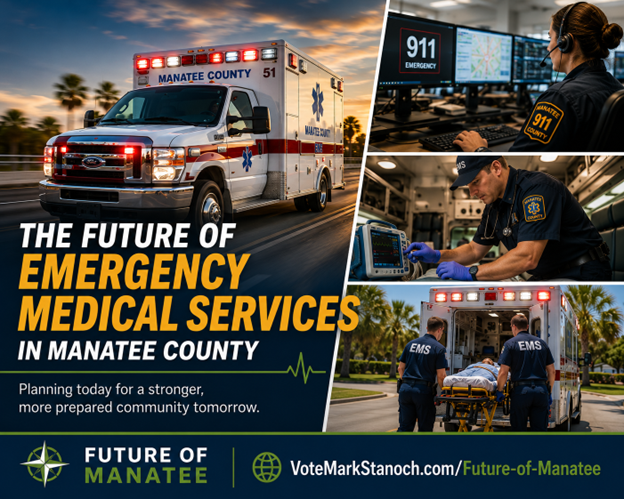
The Future of Emergency Medical Services in Manatee County
Most of us never think about emergency medical services until the moment we need them.
A loved one suffers a heart attack. A child has difficulty breathing. A serious accident happens on the road ahead. In those moments, there is no time to wonder how ambulances are dispatched, whether enough paramedics are on duty, or how long it will take help to arrive. We simply expect trained professionals to answer the call.
That expectation is exactly why emergency medical services deserve our attention long before we dial 911.
Recently, I had the opportunity to speak with Keith Lock, former District Chief of EMS Operations for Manatee County. After decades of serving our community, Keith offered valuable insight into what it takes to build an emergency medical system capable of serving one of Florida’s fastest-growing counties.
Our conversation reinforced something I have come to believe throughout this campaign: emergency medical services are not simply another county department. They are an essential service. I agree with the Manatee County Board of County Commissioners that EMS should be classified as an essential service because, when lives are on the line, nothing is more important than ensuring highly trained professionals arrive quickly and prepared.
Keith made an observation that has stayed with me:
“People don’t think about EMS until the day they need us. But when someone calls 911, they expect highly trained professionals to arrive quickly. That expectation doesn’t happen by accident.”
He is absolutely right. When emergency medical services are doing their job well, most people never notice. Behind every ambulance response is an extensive network of dispatchers, paramedics, EMTs, supervisors, training programs, advanced equipment, and strategically located stations working together every hour of every day.
The public sees an ambulance pulling into a driveway. What they rarely see are the years of planning, training, coordination, and investment that made that response possible.
The goal is simple: when someone calls 911, help is already on its way.
Growth Changes Everything
Manatee County continues to attract new residents and businesses. That growth creates tremendous opportunities, but it also creates new responsibilities.
Every new neighborhood means more people who may someday need emergency care. Every additional mile of roadway creates new areas that must be served quickly. Population growth changes where emergency resources need to be located and how they are deployed throughout the county.
Maintaining excellent EMS service is not simply about reacting to growth. It is about planning ahead. Keith explained it this way:
“Every new neighborhood changes the equation. As the county grows, emergency resources have to grow with it. You can’t wait until response times start slipping before you add stations or units.”
That observation gets to the heart of what county commissioners should be thinking about. Good government is proactive, not reactive. We should anticipate the needs of tomorrow instead of waiting until today’s systems become overwhelmed.
For me, one measure stands above all others: response time.
When someone is suffering a heart attack, a stroke, or traumatic injuries after an automobile accident, every minute matters. The most important measure of EMS service delivery is not the number of ambulances we own or the size of the department. It is how quickly highly trained professionals reach someone whose life may depend on them. As Manatee County continues to grow, maintaining excellent response times must remain one of county government’s highest priorities.
The People Behind the Uniform
Modern ambulances carry sophisticated equipment that would have been unimaginable a generation ago. Today’s paramedics have access to advanced cardiac monitors, ventilators, mechanical CPR devices, medications, and lifesaving technology that dramatically improves patient care. But technology does not replace experience.
Keith put it perfectly:
“The most expensive equipment in an ambulance doesn’t save lives by itself. It’s the EMTs and paramedics using that equipment, backed by training and experience, that make the difference.”
He’s right. The most valuable resource inside every ambulance is the highly trained professional using that equipment. Keith emphasized that continuing education and professional development should always remain priorities. Medicine evolves rapidly. New research, new procedures, and higher standards of care require emergency personnel to continue learning throughout their careers.
One opportunity worth exploring is strengthening partnerships with institutions like Manatee Technical College, helping create even stronger pathways for education, training, and career development for future EMTs and paramedics. Communities that invest in developing skilled professionals build stronger emergency systems for everyone.
Building Careers, Not Just Filling Positions
Like many public safety agencies across the country, EMS faces challenges in recruiting and retaining experienced professionals. Emergency medicine is demanding work. Long hours, physically and emotionally difficult situations, and the stress of responding to life-threatening emergencies take a toll over time.
Keith believes one of the biggest challenges facing EMS today is creating an environment where talented people choose to build long careers.
“People stay where they feel valued. If you want experienced paramedics to build careers here, you have to create an environment where they can succeed professionally and personally.”
Competitive compensation, opportunities for advancement, thoughtful scheduling, continuing education, professional recognition, and engaged leadership all contribute to retaining experienced personnel. Every community benefits when its most seasoned EMTs and paramedics remain in the field, mentoring younger professionals while continuing to serve residents.
Excellence Should Always Be the Goal
Toward the end of our conversation, Keith shared a vision that resonated with me:
“Communities don’t build outstanding EMS systems by accident. They build them through long-term planning, investment in people, continuous training, and a commitment to excellence.”
That philosophy applies far beyond emergency medical services. Throughout this campaign, I have written extensively about responsible growth, transportation, economic development, and government transparency. Each of those topics shares one common thread: successful communities prepare for tomorrow instead of simply reacting to today’s problems.
Emergency medical services deserve that same long-term commitment. I believe Manatee County should aspire to have one of the finest EMS systems in Florida. That goal is not achieved through a single budget cycle or one policy decision. It requires consistent planning, investment in people, continuous evaluation, and leadership willing to look beyond immediate challenges.
Emergency medical services should never be viewed as just another county department. They are an essential service that protects every resident, every visitor, and every family that calls Manatee County home.
Looking Ahead
One of the best measures of a community is how it responds when someone experiences the worst day of their life. Most of us hope we never need an ambulance. But if that day comes, we all want the same thing: confidence that highly trained professionals will arrive quickly, equipped with the knowledge, experience, and tools necessary to provide exceptional care.
Speaking with Keith Lock reinforced my belief that effective emergency medical services begin long before anyone dials 911. They begin with thoughtful planning, well-trained professionals, strategic station placement, modern equipment, and leadership that understands the importance of preparing for tomorrow instead of reacting to yesterday.
I agree with the Manatee County Board of County Commissioners that EMS should be classified as an essential service. I also believe the most important measure of EMS service delivery is response time, because every minute matters when lives are on the line.
One of the primary responsibilities of county government is to ensure that essential emergency services are properly funded, properly staffed, and equipped to protect the people who depend on them. That responsibility becomes even more important as Manatee County grows.
Some projects can sometimes wait. Many worthy priorities compete for limited public resources. But when someone suffers a heart attack, a stroke, or a serious accident, help cannot wait.
That is why I believe emergency medical services must always remain one of county government’s highest priorities. By planning ahead, supporting the dedicated professionals who answer the call every day, and committing ourselves to continuous improvement, we can build an EMS system that every resident can depend on and one that all of Manatee County can be proud of.
Key Takeaways
- Traffic is about planning, not just pavement.
- Connected neighborhoods reduce congestion.
- Collector roads keep local traffic off major roads.
- More local jobs mean fewer long commutes.
- Smart planning today creates a better transportation system tomorrow.
Frequently Asked Questions
Why isn’t widening Moccasin Wallow Road enough?
Additional lanes are important and will continue to be part of the solution. However, if nearly every neighborhood depends on the same road for even the shortest trips, congestion will eventually return. Building a connected transportation network helps distribute traffic more efficiently.
What are collector roads?
Collector roads are local roads that connect neighborhoods to one another before traffic reaches major arterial roads like Moccasin Wallow Road. They help keep short local trips from adding unnecessary congestion on the county’s busiest corridors.
Can the County Commission improve neighborhood connectivity?
The County Commission plays an important role in long-range planning, land-use decisions, development agreements, and transportation planning. By encouraging developments that connect with surrounding communities, the county can build a stronger transportation network over time.
How do local jobs affect traffic?
When more residents can find quality jobs in Manatee County, fewer people need to commute long distances each day. That reduces traffic while strengthening the local economy and improving quality of life.
Can technology improve traffic flow?
Yes. Adaptive traffic signals, traffic modeling, and data-driven planning help the county make smarter infrastructure decisions and improve the efficiency of existing roads.
What is the long-term goal?
The goal is to build a connected transportation network that provides residents with more choices, supports responsible growth, reduces unnecessary congestion, and improves everyday life.
Related Articles
Is Manatee County a Net Exporter of Labor?
Learn how commuting patterns affect traffic, economic growth, and why attracting more local employers is an important transportation strategy.
Making Manatee County Government Easier to Understand
Discover how technology and data-driven decision-making can improve transportation planning and county services.
Are Manatee County Residents Really Getting Ahead?
Explore how affordability, wages, housing costs, and quality of life are connected to transportation and economic opportunity.
Florida Is Growing by Millions: What Does That Mean for Manatee County?
With Florida projected to exceed 25 million residents and Manatee County expected to add roughly 70,000 by 2030, what do these trends mean for the future of our community?
The future of Manatee County will be shaped by the decisions we make today. If you found this article helpful, I invite you to follow my Facebook page for regular updates, new articles, community discussions, and insights into the issues shaping our county.
Together, we can build a future where more residents have the opportunity to live, work, and play in the same community they proudly call home.