You may also be interested in...
Live, Work, and Play:
How Economic Development Can Reduce Traffic and Help Preserve Rural Areas
Summary
Traffic congestion has become a defining challenge for many Manatee County residents, but solving it requires more than widening roads or building new intersections. The places where people live, work, and spend their time are deeply connected. By creating more employment opportunities closer to home and encouraging balanced, thoughtful growth, Manatee County can reduce long commutes, strengthen its economy, and help preserve the rural character that has long been part of its identity.
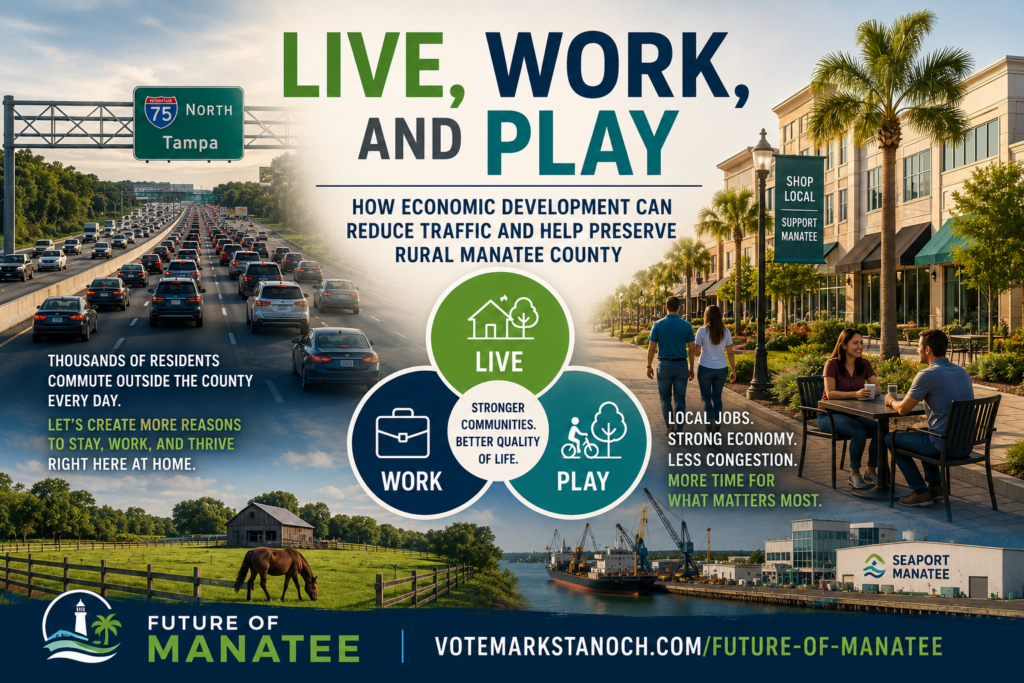
Every morning, thousands of Manatee County residents begin the same ritual. They leave home before sunrise, merge onto Interstate 75, and head north toward jobs in Hillsborough, Pinellas, or Sarasota counties. In the evening, they make the same journey in reverse, often spending more time in traffic than they do sharing dinner with their families.
When conversations turn to traffic, the solutions usually sound familiar. Build another lane. Widen another highway. Add another interchange.
Those investments are important, but they address only part of the problem.
Traffic does not begin when someone starts a car. It begins much earlier, when a community grows faster than its local economy. Every neighborhood built without nearby employment creates thousands of future trips. Every new resident who must travel thirty or forty miles to work adds another vehicle to roads that are already struggling to keep pace.
Seen through that lens, traffic is not simply a transportation issue. It is also an economic development issue.
The Hidden Cost of the Daily Commute
Traffic congestion is one of the most visible challenges facing Manatee County, but the real issue extends far beyond crowded highways. It reflects a disconnect between where people live and where they work.
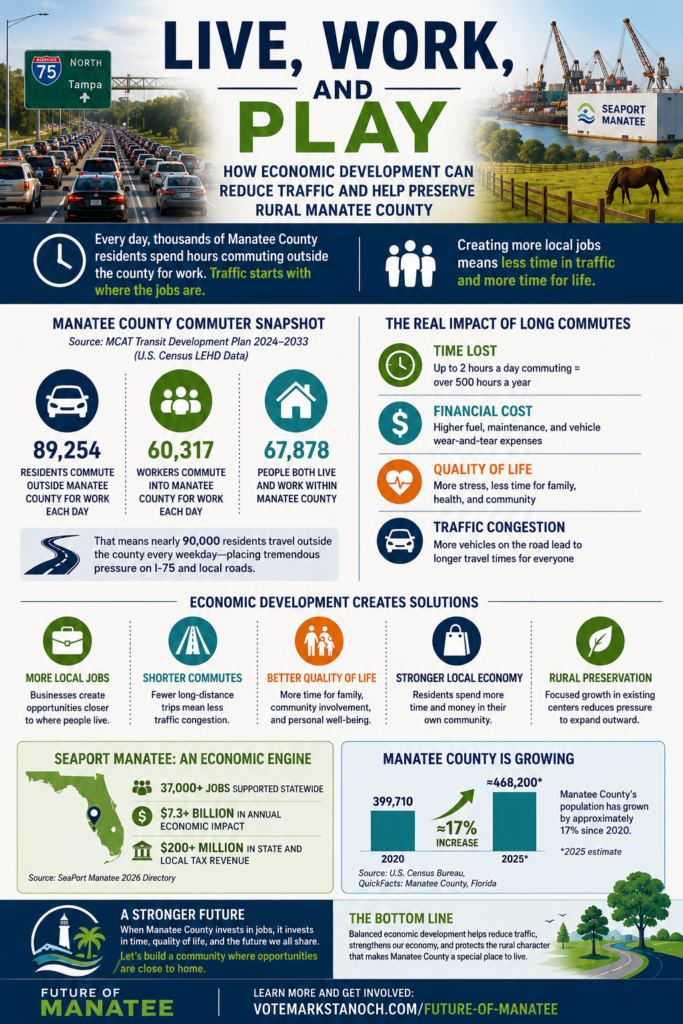
According to the Manatee County Area Transit (MCAT) 2024–2033 Transit Development Plan, approximately 89,254 Manatee County residents work outside the county, while 60,317 workers commute into Manatee County each day. Another 67,878 residents both live and work within the county. These figures are based on U.S. Census Longitudinal Employer Household Dynamics (LEHD) employment data. Florida Commerce’s 2024 Summary of Employment, Demographics, and Commuting Patterns reports a nearly identical 88,193 residents living in Manatee County and working elsewhere, reinforcing the scale of the county’s daily commuter outflow.
The numbers reveal a fundamental challenge. While more than 60,000 people commute into Manatee County each day, even more residents leave the county to earn a living. Many travel to neighboring employment centers in Sarasota, Hillsborough, and Pinellas counties, placing tremendous pressure on the county’s major transportation corridors.
The costs are measured in more than traffic delays. Long commutes consume hours that could be spent with family, volunteering in the community, coaching youth sports, supporting local businesses, or simply enjoying a better quality of life. They also increase fuel costs, vehicle maintenance expenses, and stress for thousands of working families.
Road improvements remain essential as Manatee County continues to grow. However, transportation alone cannot solve the problem. Creating more high quality jobs within Manatee County would allow more residents to work closer to home, reducing congestion while strengthening the local economy. And of course, higher household incomes would increase the rate of home ownership and reduce the likelihood of government subsidies. When people can live, work, and play in the same community, everyone benefits.
“Live, Work, and Play” Really Means
The phrase “Live, Work, and Play” appears in community planning documents across the country and is often misunderstood as a marketing slogan. In reality, it describes something much more fundamental.
Healthy communities are built around balance.
Housing, employment, schools, healthcare, shopping, parks, and recreation should grow together rather than independently. When homes are added much faster than jobs, residents are left with little choice but to commute elsewhere. The result is predictable: more traffic, longer travel times, and increased demand for costly road expansions.
Balanced growth asks a different question. Instead of simply asking where new homes should be built, it also asks where future jobs will come from.
That shift in perspective changes everything.
Economic development is not only about attracting businesses or expanding the tax base. It is also about giving residents more opportunities to spend less time driving and more time living within their own community. A parent who works thirty minutes from home experiences Manatee County very differently than one who spends two hours each day on Interstate 75.
Communities flourish when people have enough time to participate in them.
Strong Economies Can Help Preserve Rural Communities
Growth debates often present economic development and rural preservation as if they are opposing goals. They do not have to be. With thoughtful planning, a stronger economy can actually help protect the rural character that makes Manatee County unique.
When employment centers are strengthened in areas already served by infrastructure, businesses have room to expand without pushing development farther into agricultural land. Concentrating jobs in appropriate locations reduces pressure to continually extend residential development into rural areas simply because employment opportunities remain elsewhere.
SeaPort Manatee offers a compelling example of this principle. According to the 2026 SeaPort Manatee Directory, the port generates more than $7.3 billion in annual economic impact and supports more than 42,000 direct and indirect jobs throughout Florida. Beyond moving cargo, the port supports manufacturing, logistics, construction, engineering, agriculture, and skilled trades that provide rewarding careers closer to home. A stronger regional economy means more residents can build successful careers without leaving Manatee County each day.
Investments like these make better use of existing infrastructure while creating high quality jobs closer to where people live. Fewer long distance commutes mean less pressure on regional highways and less incentive to push new residential development farther into agricultural land. That is how economic development and conservation can work together rather than compete with one another.
Protecting rural Manatee County is not achieved by opposing every new project. It is achieved by guiding growth toward places where it creates lasting economic value while preserving the farms, ranches, and open spaces that define the county’s unique character.
A Different Way to Think About Growth
Growth is no longer a question for Manatee County. It is a reality.
According to the U.S. Census Bureau, the county’s population has grown by approximately 17% since 2020, making it one of Florida’s fastest growing communities. New neighborhoods, new schools, and new businesses are changing the landscape at a remarkable pace. That growth brings tremendous opportunities, but it also demands thoughtful planning and long term vision.
The challenge is not choosing between economic development and preserving quality of life. The two are connected.
When more residents can find rewarding careers close to home, the benefits extend far beyond the workplace. Shorter commutes reduce congestion on Interstate 75 and other major corridors. Families gain more time together. Local businesses benefit from customers who spend more time and money in the community. Infrastructure investments stretch further because existing roads carry fewer long-distance commuters.
This is the essence of a balanced “Live, Work, and Play” community. Homes, businesses, schools, healthcare, parks, and recreation should complement one another rather than develop independently. Economic development is not simply about creating jobs. It is about creating communities where people have the opportunity to build their careers, raise their families, and enjoy their lives without spending hours each week behind the wheel.
Perhaps the ultimate measure of success is not how many miles of roadway we build, but how much time we give back to the people who call Manatee County home.
Communities are ultimately measured by the lives they make possible. Success is not simply measured by the number of businesses that open or the miles of roadway that are built. It is measured by whether parents can spend more evenings with their children, whether young adults can build careers without leaving the community they love, and whether future generations inherit both a thriving economy and the rural landscapes that make Manatee County special. When people have the opportunity to live, work, and play in the same community, everyone benefits.
Key Takeaways
- Traffic congestion is influenced by where people work, not just where they live.
- Approximately 89,000 Manatee County residents commute outside the county for work each day, placing significant pressure on Interstate 75 and other regional transportation corridors.
- Creating more local employment opportunities can reduce commuting distances while improving quality of life.
- Economic development and rural preservation can complement one another when growth is directed toward existing employment centers.
- A balanced “Live, Work, and Play” approach can strengthen the economy while helping preserve the character that makes Manatee County unique.
Frequently Asked Questions
What does “Live, Work, and Play” mean?
It is a planning approach that encourages housing, employment, schools, healthcare, shopping, and recreation to develop together. By creating communities where residents can live close to their jobs and everyday services, the need for long daily commutes is reduced while quality of life improves.
Can economic development really reduce traffic?
Economic development alone cannot eliminate congestion, but it can reduce one of its primary causes. Creating more employment opportunities within Manatee County allows more residents to work closer to home, reducing long distance commuting while complementing investments in roads, bridges, and other transportation infrastructure.
Why is SeaPort Manatee important?
SeaPort Manatee is one of Florida’s most important economic engines, generating more than $7.3 billion in annual economic impact and supporting more than 42,000 direct and indirect jobs. Beyond moving cargo, the port attracts manufacturers, logistics companies, and other employers that create high quality careers closer to where Manatee County residents live.
Does preserving rural land mean stopping growth?
No. Responsible growth does not mean preventing development. It means directing growth toward areas that already have infrastructure while protecting agricultural land, natural resources, and the rural landscapes that define Manatee County’s character.
Related Articles
Is Manatee County a Net Exporter of Labor?
Learn why thousands of residents leave the county each day for work and how creating more local job opportunities can strengthen families, reduce traffic, and improve quality of life.
Are Manatee County Residents Really Getting Ahead?
Explore the relationship between income growth, rising costs, and why many residents still feel financially squeezed despite positive economic indicators.
Why Housing Feels Unaffordable in Manatee County
Understand how wages, housing costs, and economic opportunity are interconnected and why local job growth matters to affordability.
Why More Roads Alone Will Not Solve Manatee County’s Traffic Challenges
Long-term congestion will require not only transportation improvements, but also economic development that brings more high-paying jobs.
Stay Connected
The future of Manatee County will not be shaped by any single project, industry, or policy. It will be shaped by how well we connect economic opportunity, workforce development, infrastructure, housing, education, and quality of life.
If you found this article helpful, I invite you to follow my Facebook page for new articles, community discussions, research, and ideas focused on building a stronger future for Manatee County.
Together, we can create more opportunities closer to home while preparing the next generation for success.