You may also be interested in...
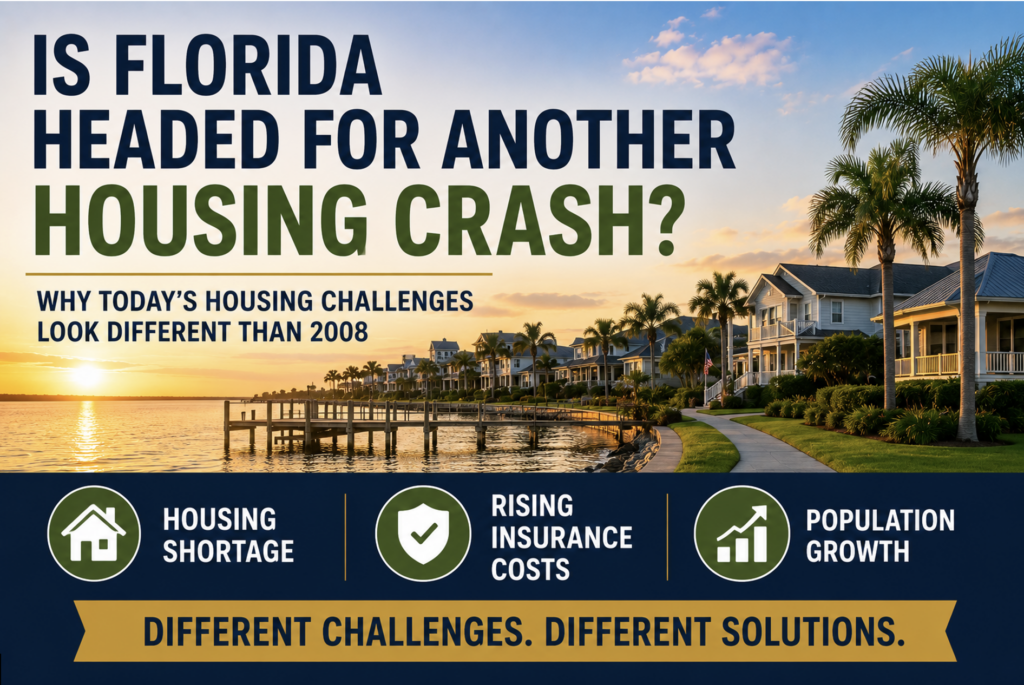
Is Florida Headed for Another Housing Crash?
Why Today’s Housing Challenges Look Different Than 2008
Summary
Rising housing costs, increasing insurance premiums, and headlines about growing foreclosure activity have many Floridians wondering whether the state is headed for another housing crash.
The short answer is no.
Florida faces serious housing challenges, but the conditions driving today’s market are very different from those that led to the collapse of 2008. Rather than being fueled by excessive speculation and risky lending, today’s affordability crisis is largely the result of a housing shortage, rising insurance costs, strong population growth, and incomes that have struggled to keep pace with the cost of living.
Understanding those factors is important because the solutions to today’s challenges will look very different from the solutions of the past.
Why People Are Asking the Question
For many Floridians, housing has become increasingly difficult to afford.
Home prices rose dramatically during and after the pandemic. Insurance premiums have climbed sharply in many parts of the state. At the same time, reports of increasing foreclosure activity have raised concerns that another housing collapse may be on the horizon.
Those concerns are understandable. The memory of the 2008 housing crash still looms large for many families. However, the data suggests that today’s housing market faces a different set of challenges.
Why This Is Not 2008
The housing crash of 2008 was driven largely by risky lending practices, speculative buying, and homeowners who found themselves owing more than their homes were worth.
Today’s market looks very different.
Most homeowners have significant equity in their homes. Mortgage underwriting standards are far stronger than they were prior to the Great Recession, and foreclosure activity remains only a fraction of what Florida experienced between 2008 and 2010.
While foreclosures have increased, experts generally view them as a symptom of affordability pressures rather than evidence of a collapsing housing market. That distinction matters because it points toward a very different diagnosis—and a very different set of solutions.
The Supply Problem
One of the most significant challenges facing Florida is a simple imbalance between supply and demand.
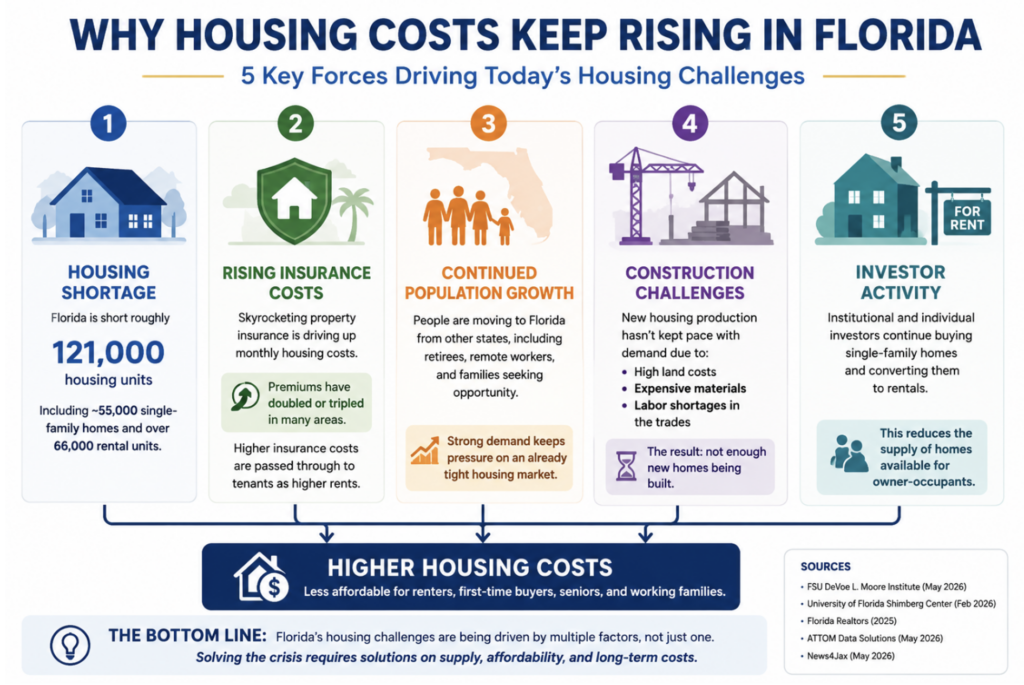
Researchers estimate that Florida is currently short approximately 121,000 housing units, including roughly 55,000 single-family homes and more than 66,000 rental units. When demand exceeds supply, prices rise. While that principle is straightforward, the forces contributing to Florida’s housing shortage are complex.
Construction has struggled to keep pace with population growth. Land costs have increased. Building materials remain expensive. Labor shortages in the construction trades continue to limit production. The result is a housing market that remains under pressure even as inventory levels improve.
The Insurance Challenge
Housing affordability is about far more than the purchase price of a home. For many homeowners, insurance has become one of the fastest-growing components of monthly housing costs. In some areas, premiums have doubled or even tripled in recent years due to hurricane risk, litigation costs, and insurers leaving the Florida market.
Those increases affect more than homeowners.
Landlords often pass higher insurance costs on to tenants through increased rents. Property owners facing rising expenses may delay improvements or maintenance. Families on fixed incomes can find themselves struggling to keep up even if their mortgage payments remain unchanged. In many cases, insurance costs have become one of the most important drivers of housing affordability in Florida.
Population Growth Continues
Florida remains one of the fastest-growing states in the country. Retirees, remote workers, and families relocating from higher-cost states continue to move here in significant numbers. Many are attracted by Florida’s climate, economic opportunities, and quality of life.
Growth brings many benefits, including new investment, expanded business activity, and increased economic opportunity. However, growth also creates demand for housing, roads, schools, utilities, and public services. When infrastructure and housing production fail to keep pace, affordability pressures increase.
Growth itself is not the problem. The challenge is ensuring that growth is managed responsibly and accompanied by the infrastructure and housing needed to support it.
Why This Matters to Manatee County
Although this is a statewide issue, the effects are felt locally. Residents throughout Manatee County are experiencing the same affordability pressures affecting communities across Florida. Rising housing costs, insurance premiums, and population growth all influence the local housing market.
At the same time, affordability is closely connected to economic opportunity.
Many residents continue to commute outside the county for higher-paying employment opportunities. When housing costs rise faster than local wages, affordability challenges become even more pronounced. This is one reason why conversations about housing, transportation, workforce development, and economic growth are so closely connected. Each affects the others.
Looking Ahead
Florida’s housing challenges did not develop overnight, and they will not be solved by any single policy or program.
Addressing affordability will require a combination of increased housing supply, responsible growth management, workforce development, infrastructure investment, and stronger economic opportunities for working families.
It will also require honest conversations about the factors driving housing costs. The reality is that today’s affordability challenges are the result of multiple forces working together rather than a single cause. Understanding those forces is the first step toward building solutions that are practical, sustainable, and effective.
The goal should not simply be more growth or less growth. The goal should be creating communities where families can build stable lives, find economic opportunity, and enjoy a high quality of life for generations to come.
Key Takeaways
- Florida is facing a housing affordability crisis, but it is not a repeat of the 2008 housing crash.
- The state is estimated to be short approximately 121,000 housing units.
- Rising insurance costs have become a major contributor to housing affordability challenges.
- Population growth continues to place pressure on housing demand.
- Foreclosures are increasing but remain far below 2008 levels.
- Housing affordability is connected to broader issues including economic opportunity and workforce development.
Want to Dive Deeper?
This article summarizes key findings from research and data prepared for the Future of Manatee County initiative. Readers interested in reviewing the underlying data, charts, and supporting analysis can access the full report below.
Get Inside the Trends and Statistics
Frequently Asked Questions
Is Florida experiencing another housing bubble?
Current market conditions differ significantly from those that led to the 2008 housing crash. Most experts view today’s challenges as an affordability and supply issue rather than a speculative housing bubble.
Why are housing costs still rising?
Housing costs are being driven by a combination of supply shortages, insurance costs, population growth, construction challenges, and continued demand.
Why have insurance costs increased so much?
Factors include hurricane risk, litigation costs, reinsurance expenses, and the departure of insurers from the Florida market.
Is Florida building enough housing?
Current research suggests the state remains significantly short of the housing units needed to meet demand.
How does this affect Manatee County?
The same statewide forces influencing housing affordability are also affecting residents throughout Manatee County.
Related Articles
Why Housing Feels Unaffordable in Manatee County
Are Manatee County Residents Really Getting Ahead?
Is Manatee County a Net Exporter of Labor?
Live, Work and Play: How Economic Development Can Reduce Manatee County’s Traffic Crisis and Preserve Rural Areas
What Is Seaport Manatee and Why Does It Matter?
The future of Manatee County will be shaped by the decisions we make today. If you found this article helpful, I invite you to follow my Facebook page for regular updates, new articles, community discussions, and insights into the issues shaping the future of Manatee County.
Together, we can build a future where more residents have the opportunity to live, work, and play in the same community they proudly call home.