You may also be interested in...

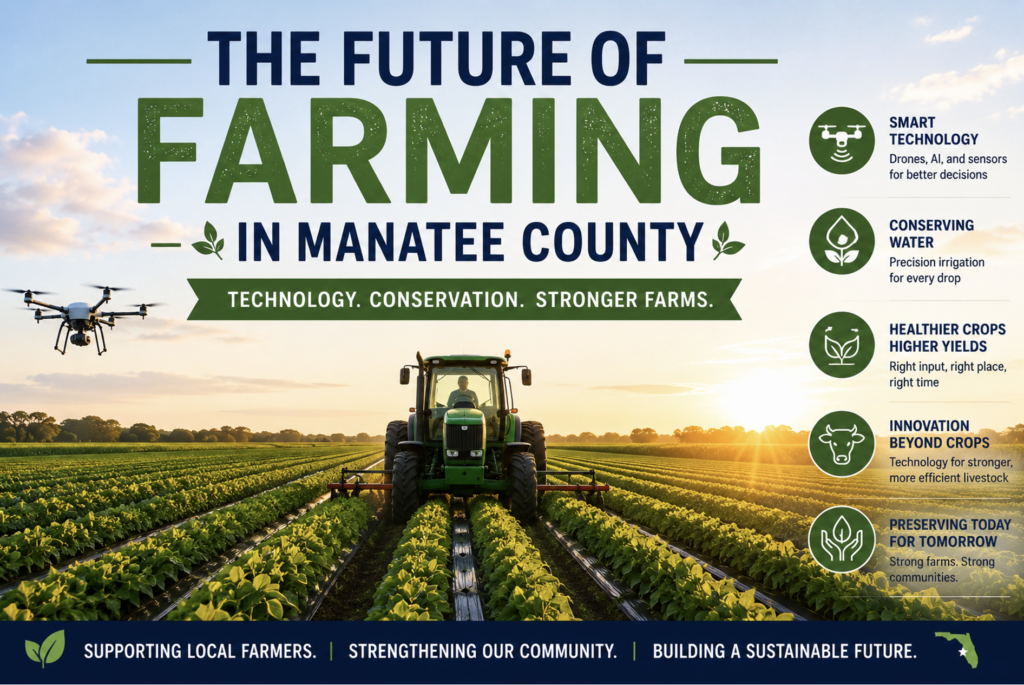
How Technology Can Help Preserve Farming in Manatee County
Innovation, Conservation, and the Future of Agriculture
Summary
When people think about preserving agriculture in Manatee County, they often focus on land use, development pressures, and protecting rural areas. Those conversations are important, but there is another part of the equation that receives far less attention: helping farms remain economically viable.
Agriculture remains one of Manatee County’s most important industries. The county ranks second in Florida for vegetable production and is the state’s leading producer of fresh market tomatoes. Local farms also produce peppers, watermelons, cucumbers, potatoes, citrus, and a wide range of specialty crops, while the livestock sector contributes more than $35 million annually to the local economy.
Today, new technologies are helping farmers increase yields, conserve water, reduce costs, and adapt to changing conditions. These innovations may play an important role in ensuring that agriculture remains a vibrant part of Manatee County’s future.
Why Agriculture Matters
For many residents, agriculture is part of Manatee County’s identity.
Long before the area’s recent population growth, farming helped shape the local economy, culture, and landscape. Even today, agriculture remains a major economic driver and an important part of what makes eastern Manatee County unique.
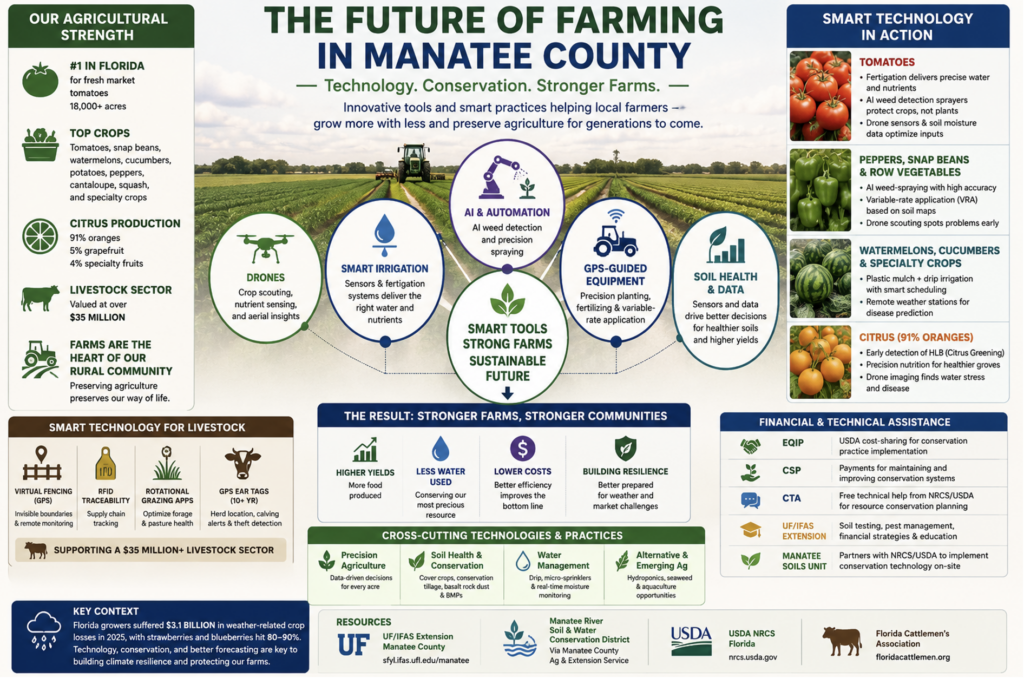
Many residents are surprised to learn that Manatee County ranks among Florida’s agricultural leaders. The county is the state’s top producer of fresh market tomatoes, with more than 18,000 acres dedicated to tomato production alone. Local growers also produce snap beans, peppers, potatoes, cucumbers, watermelons, cantaloupes, squash, citrus, and numerous specialty crops.
Agriculture provides jobs, supports local businesses, contributes to the tax base, and helps preserve the rural character that many residents value.
Farming Is Becoming High-Tech
Modern agriculture looks very different from the image many people have in mind.
Today’s farmers increasingly rely on data, sensors, GPS technology, drones, and artificial intelligence to make better decisions and improve efficiency. These tools help growers use resources more effectively while reducing waste and environmental impacts.
Some of the technologies already being used or developed for Florida agriculture include:
- AI-powered weed detection systems that identify and target weeds while protecting crops
- Drone-based nutrient sensing that helps determine fertilizer needs in real time
- GPS-guided equipment that adjusts planting and fertilizer applications based on field conditions
- Soil moisture sensors that optimize irrigation and reduce water use
- Precision nutrient programs that improve crop health and productivity
Many of these innovations allow farmers to produce more food while using fewer resources.
Water Is the Critical Resource
If there is one resource that defines Florida agriculture, it is water.
Manatee County’s sandy soils require careful water management, and farmers must balance productivity with conservation. This challenge becomes even more important as population growth places additional demands on water resources.
Fortunately, technology is helping farmers become more efficient than ever before.
Drip irrigation systems, moisture sensors, weather monitoring stations, and precision irrigation tools allow growers to deliver water only when and where it is needed. Rather than relying on estimates, farmers can make decisions based on real-time data. The result is better crop performance, lower water use, and improved environmental stewardship.
Technology Beyond Crops
Innovation is also transforming livestock operations. Local ranchers are increasingly adopting technologies that would have seemed futuristic just a few years ago.
Examples include:
- Virtual fencing systems that use GPS rather than traditional fencing
- GPS ear tags that monitor herd locations and provide calving alerts
- Digital grazing management tools that improve forage utilization
- RFID tracking systems that support animal health and supply chain management
These technologies help producers improve efficiency while reducing labor demands and operational costs.
Helping Farms Stay Farms
One of the greatest challenges facing agriculture is economic pressure.
Farmers must contend with rising costs, weather risks, labor shortages, and competition from around the world. In Florida alone, weather-related agricultural losses exceeded $3 billion in 2025. When farms become less profitable, development pressure naturally increases. Selling land may appear more attractive than continuing agricultural operations.
That is why technology matters.
The more productive, efficient, and resilient farms become, the more likely they are to remain economically viable for future generations. Innovation is not a substitute for good land-use policy, but it is an important part of keeping agriculture competitive and supporting the people who make their living from the land.
Looking Ahead
The future of agriculture in Manatee County will likely involve a combination of tradition and technology. The values that have sustained farming for generations—hard work, stewardship, and resilience—remain as important as ever. What is changing are the tools available to help farmers succeed.
If Manatee County wants to preserve its agricultural heritage, it must also support the economic viability of agriculture itself. Helping farmers become more productive, efficient, and resilient is one way to ensure that farming remains a meaningful part of our community for generations to come.
Key Takeaways
- Manatee County ranks second in Florida for vegetable production and leads the state in fresh market tomato production.
- Agriculture remains a major contributor to the local economy.
- Technologies such as drones, AI, GPS guidance, and precision irrigation are transforming modern farming.
- Water conservation technologies are becoming increasingly important.
- Livestock operations are also benefiting from innovation.
- Stronger, more profitable farms are more likely to remain viable for future generations.
Want to Dive Deeper?
This article summarizes key findings from research and data prepared for the Future of Manatee County initiative. Readers interested in reviewing the underlying data, charts, and supporting analysis can access the full report below.
Get Inside the Trends and Statistics
Frequently Asked Questions
Is agriculture still important to Manatee County?
Yes. Agriculture remains one of the county’s most significant industries and contributes substantially to the local economy.
What crops are most commonly grown in Manatee County?
Tomatoes are the county’s leading crop, followed by peppers, snap beans, cucumbers, potatoes, watermelons, citrus, and specialty crops.
How are farmers using artificial intelligence?
AI systems are being developed to identify weeds, monitor crops, optimize inputs, and support farm management decisions.
Why is water management so important?
Florida’s sandy soils and growing population make efficient water use critical for long-term agricultural sustainability.
Can technology help preserve agriculture?
Technology can improve productivity, reduce costs, conserve resources, and help farms remain economically viable in the face of increasing pressures.
Related Articles
What Is Seaport Manatee and Why Does It Matter?
Seaport Manatee, a major gateway for trade, may be one of the most important economic assets in Florida and one of the greatest opportunities for Manatee County’s future.
Are Manatee County Residents Really Getting Ahead?
Explore the relationship between income growth, rising costs, and why many residents still feel financially squeezed despite positive economic indicators.
Why Housing Feels Unaffordable in Manatee County
Understand how wages, housing costs, and economic opportunity are interconnected and why local job growth matters to affordability.
Is Florida Headed for Another Housing Crash?
Florida faces serious housing challenges, but the conditions driving today’s market are very different from those that led to the collapse of 2008.
The future of Manatee County will be shaped by the decisions we make today. If you found this article helpful, I invite you to follow my Facebook page for regular updates, new articles, community discussions, and insights into the issues shaping the future of Manatee County.
Together, we can build a future where more residents have the opportunity to live, work, and play in the same community they proudly call home.