You may also be interested in...
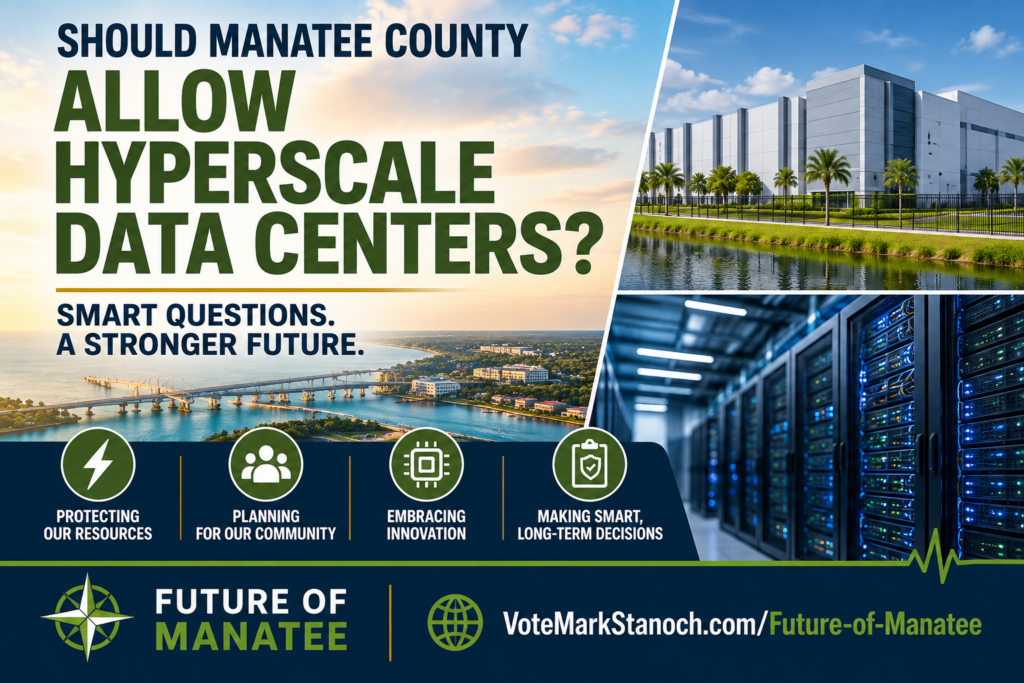
Should Manatee County Allow Hyperscale Data Centers?
Summary
AI is changing our world, but that does not mean Manatee County should automatically welcome every type of AI infrastructure. Hyperscale data centers can place enormous demands on electricity, land, and other community resources, so we need to understand what we are considering before making long-term decisions. With my background in technology and systems architecture, I understand both the capabilities of today’s AI systems and how quickly their underlying infrastructure can change. I support innovation, but I also believe Manatee County should protect its residents and make decisions based on sound planning rather than technology hype. That is why I support the cautious approach being taken by our county and state leaders
Artificial intelligence is changing the way we work, communicate, learn, and do business. Whether you’re using ChatGPT, Microsoft Copilot, or AI-powered search tools, you’ve already experienced how quickly this technology is becoming part of everyday life.
With that growth has come understandable concern here in Manatee County. Residents have asked whether the massive hyperscale data centers being proposed around the country could eventually be built here and, if so, what that might mean for our electrical grid, water resources, infrastructure, and quality of life.
Those are fair questions, and they deserve clear answers.
The good news is that Manatee County is not rushing into this issue. The Board of County Commissioners has already directed county staff to prepare an ordinance establishing standards for future data center development. At the same time, Governor Ron DeSantis recently signed legislation preventing extremely large data centers with peak electrical demands exceeding 50 megawatts from shifting the cost of new electrical infrastructure onto local utility customers. Together, those actions demonstrate that state and local leaders are taking a thoughtful approach instead of reacting after the fact.
Before deciding whether hyperscale facilities belong in Manatee County, it’s important to understand that not all data centers are the same.
Understanding the Difference
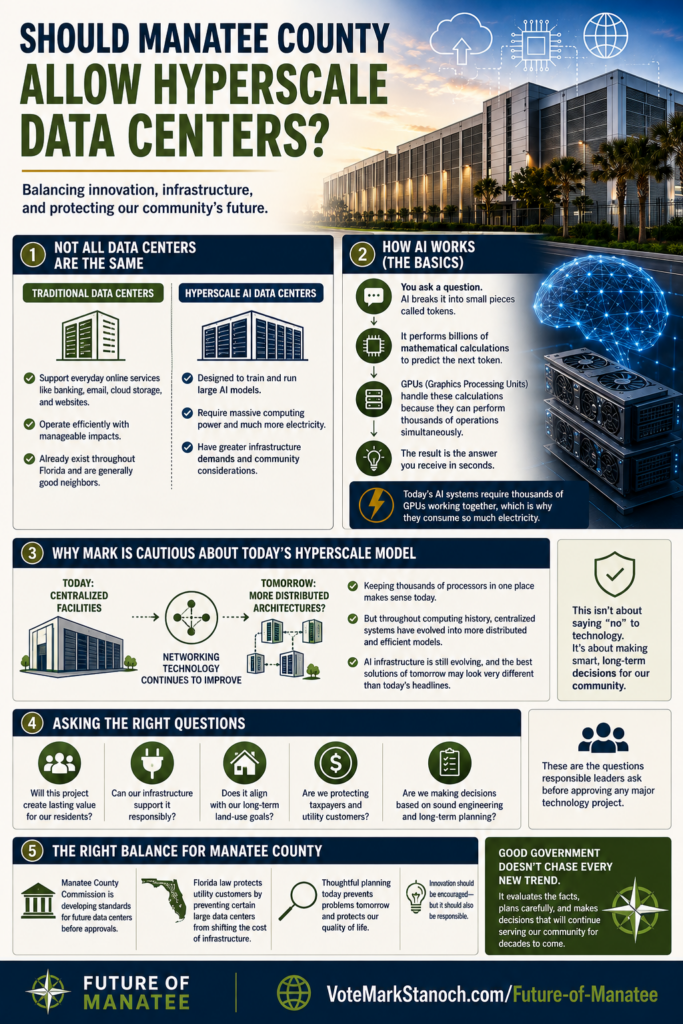
Traditional data centers have existed for decades and quietly support many of the online services we depend on every day. Banking, Microsoft Office, cloud storage, websites, email, and social media all rely on facilities like these. Data centers already operate throughout Florida, including the Tampa Bay area, and generally make good neighbors because they provide valuable services without placing extraordinary demands on local communities.
Hyperscale AI data centers are different. Instead of primarily storing information or hosting business applications, they are designed to train and operate extremely large artificial intelligence models. That requires dramatically more computing power and significantly greater electrical demand than traditional data centers.
Understanding that distinction is the key to understanding this discussion.
My Background Matters
Throughout my career in enterprise technology, software development, and systems architecture, I’ve learned that the best technology decisions come from understanding how systems work—not simply following headlines.
Large Language Models, or LLMs, don’t “think” the way people do. They break language into small pieces called tokens and perform enormous numbers of mathematical calculations to predict the next token in a sequence. Every response generated by an AI system is the result of billions of calculations taking place in fractions of a second. Those calculations are performed primarily by Graphics Processing Units, or GPUs, because GPUs are specifically designed to perform thousands of mathematical operations simultaneously.
That technology is remarkable, but it also explains why today’s AI facilities have become so large.
Current hyperscale data centers rely on massive clusters of GPUs working together in one location because keeping processors physically close together minimizes network latency and improves performance. From an engineering perspective, that approach makes sense today. The question I ask is whether it will still represent the best solution ten years from now.
Throughout the history of computing, we’ve repeatedly seen centralized systems evolve into more distributed architectures as networking technology improves. Based on my experience in enterprise technology, I believe artificial intelligence infrastructure will continue evolving as well. That doesn’t mean hyperscale facilities are “bad” technology. It simply means I believe county government should be cautious about making permanent land-use decisions based on an architecture that may change significantly over the next decade.
Asking the Right Questions
I support artificial intelligence. I support innovation. I also support attracting technology companies that create high-paying jobs and strengthen our local economy.
Supporting innovation, however, doesn’t mean approving every proposal simply because it involves new technology. Responsible government asks whether a project creates lasting value, whether local infrastructure can support it, whether taxpayers are protected, and whether the technology is mature enough to justify long-term community investment.
Those are exactly the questions I believe the County Commission should continue asking as it develops standards for future data centers.
Looking Ahead
Throughout the Future of Manatee series, I’ve written that successful communities don’t simply react to change—they prepare for it. Artificial intelligence will almost certainly become one of the defining technologies of our generation, and I want Manatee County to benefit from that innovation. At the same time, I believe we should be careful not to make permanent land-use decisions based on technology that is still evolving at an extraordinary pace.
I believe the current direction being taken by the Manatee County Commission and the State of Florida strikes the right balance. It encourages innovation while protecting residents, taxpayers, and our quality of life. That’s not being anti-technology. It’s recognizing that good government doesn’t chase every new trend. It evaluates the facts, plans carefully, and makes decisions that will continue serving our community for decades to come.
Key Takeaways
- Not all data centers are hyperscale AI facilities.
- Manatee County is developing standards before approving future data centers.
- Florida has enacted protections to prevent large AI facilities from increasing local utility costs.
- AI is evolving rapidly, making thoughtful planning essential.
- Innovation and responsible growth can—and should—go hand in hand.
Frequently Asked Questions
What is a hyperscale data center?
A hyperscale data center is a very large computing facility designed to support artificial intelligence models and other high-performance computing workloads. These facilities require significantly more computing power and electricity than traditional business data centers.
Are hyperscale data centers coming to Manatee County?
At this time, the County Commission has directed staff to develop an ordinance establishing standards for future data centers before any major projects move forward. The focus is on creating thoughtful guidelines rather than rushing into approvals.
Are all data centers the same?
No. Traditional data centers support services like cloud computing, email, banking, Microsoft Office, and websites. Hyperscale AI data centers are designed specifically for large-scale artificial intelligence processing and have much greater infrastructure requirements.
Why do hyperscale AI data centers require so much power?
Modern AI systems perform billions of mathematical calculations using specialized processors called GPUs. Today’s AI architecture relies on thousands of GPUs working together, creating much higher electrical demands than traditional computing facilities.
Why is Mark cautious about today’s hyperscale model?
Mark supports artificial intelligence and technological innovation but believes the underlying computing architecture is evolving rapidly. Based on his background in enterprise technology and systems architecture, he believes county government should be cautious about making permanent land-use decisions based on technology that may look very different in the coming decade.
What protections already exist?
The Manatee County Commission is developing local standards for future data centers, and Florida law now protects utility customers by preventing certain very large data centers from shifting electrical infrastructure costs onto local ratepayers.
Related Articles
Making Manatee County Government Easier to Understand
Learn why informed citizens make better decisions and how county government can communicate complex issues more clearly.
The Future of Seaport Manatee: Building an Economy That Works for Everyone
Explore how strategic economic development can create high-quality jobs while strengthening Manatee County’s long-term competitiveness.
Is Manatee County a Net Exporter of Labor?
Discover why attracting more high-paying jobs to Manatee County reduces commuting, strengthens the local economy, and improves quality of life.
Are Manatee County Residents Really Getting Ahead?
Read how wages, housing affordability, economic opportunity, and responsible growth all work together to shape the future of our community.
Stay Connected
If you found this article helpful, I invite you to follow my Facebook page for new articles, community discussions, research, and ideas focused on building a stronger future for Manatee County.
Together, we can create more opportunities closer to home while preparing the next generation for success.